Author Archives: celtic

Indirect Racism – A Celtic Fan’s Story


I’ve thought long and hard about writing this. “Will I? Won’t I? Will I draw unnecessary negative attention my way? Is my story worth telling?”

Then I looked at the Black Lives Matter movement, who are fighting racial injustice and systematic racism – while trying to educate on the indirect racism that still exists in this country.

What is indirect racism you may ask? Well hopefully I can tell you.

3 Stripe Glasgow Badge

What does it mean to me? And how does it affect me? How can I help to educate? I think the best way is to tell my story about indirect racism in football and normal life.

This isn’t a sob story, I’ve got a thick enough skin to deal with it. This is just my experience of being a Scottish Christian BAME Celtic fan, who lives in London.

You don’t have to agree with it, I just want you to listen because I’m about to dish out some home truths about indirect racism and racial profiling that may be uncomfortable, or not even seen as a problem, to some.

We all know what direct racism is. Blatant racist abuse or discrimination. We all know it’s not acceptable – even the majority of people who do it.

In football, I’ve experienced it – at a Chelsea match, by a local Rangers fan on MSN when I was younger, in a pub in Aberdeenshire after coming back from a Glasgow Derby many years ago and also plenty of it on Twitter.

Celtic Soul Polo-Top | Black

Luckily, I don’t experience that much, to be completely honest. But why should I have ever experienced it in the first place?

That’s not what I’m here to talk about. Because I think the majority of people in 2020 realise it’s disgusting.

I’m here to talk about indirect/subconscious racism and the need to stop racial profiling – that quite often comes from the left.

One of the main reasons I support Celtic is the fact it is a club for all. It’s the immigrant club that’s fought it’s own battles of racism and sectarianism over the years – and still does.

The anti-fascist and left wing causes mean more to me than the actual football. It’s what Celtic is all about for me. An Irish club, based in Scotland – thriving in a hostile environment and its supporters tackling deep societal issues.

Celtic Target T-Shirt / White

I’ve never seen or heard direct racist abuse at a Celtic game. That doesn’t mean there aren’t a few idiots out there – there have been some shocking incidents in the past involving some Celtic fans. But en masse Celtic fans are generally all-inclusive and welcoming.

There are people from all walks of life who go to games and watch Celtic in pubs in London – I love that.

But that’s not to say we don’t need to self-reflect in these times and think “what can we do better?”

Just because of the general anti-racism stance, doesn’t mean we are perfect. Far from it.

In my years of being a season ticket holder and on trips abroad I still get incidents where I’m made to feel different. Not a complete outsider, but just different. And when you break it down, it’s all down to the colour of my skin.

More than 90 Minutes Celtic Ezine Annual Digital Subscription

On trips away and in pubs before games I’ve had the Emilio Izaguirre song sung at me – a lot. I’ve been called Bobby Petta, Raman Bhardwaj and even Alfredo Morelos! I can’t look like all of them?!

I’ve had people come up to me to tell me about other Asian people they know and ask me if I know them. WTF?!

I’ve been mistaken for other – I can only assume – brown Celtic fans. Friendly shouts of “Raj/Omar, how you doing ma man?” Nope, that’s not me.

I’ve had someone ask what part of India I’m from. I replied “Aberdeen.” I’ve also been asked if I’m from Brazil.

When I lived in Newcastle, at the Tyneside CSC one man said the good old phrase “We’re all Jock Tamson’s bairns… except him” – pointing at me, jokingly.

1 Badge FREE 6 for 5

At the Wimbledon CSC on cup final day in December, an elderly man tapped me on the shoulder and said: “Did you enjoy that?”. I replied: “Aye, f*****g brilliant”. To which he looked shocked and said: “Oh, you’re one of us”. I was wearing a Celtic shirt.

You may think none of these incidents are remotely linked to any form of racism – but that’s exactly how indirect racism can work. It’s racial profiling.

The people can mean well and not realise they are causing any harm or offence, but they are saying it because of the colour of my skin. None of these things would happen if I was white.

You may think that these are all said in a friendly and jovial way so it’s all okay and a bit of fun. I do laugh it off, but that’s not the point. It’s making someone feel different and out of place from the rest.

I’ve experienced it on my travels with Scotland as well. In Alicante before Spain away, I’ve had someone shout at me: “You’re not Scottish”.  I’ve also had a friend’s dad repeatedly tell me this when he’s drunk. I was born in Scotland and lived there for 23 years, until I moved to London – where should I be from?

Glasgow 3 Stripe T-Shirt / Black

In a pub in Hungary, with another group of guys who were drinking with my mates – one refused to accept that my name was Tony and that I was Scottish. I laughed it off but I couldn’t help but think: “Why should I have to prove my existence and identity, when I’ve travelled all the way to Hungary for a f*****g friendly and I’m wearing a Scotland top and a kilt?!”

Away at San Marino, we were drinking outside the ground with a group of older lads from Aberdeen and one of them was about to tell a joke, to which others made him stop. “Not now”, they said. And they all looked at me after. I wonder what kind of joke he was about to tell?

Just generally, you get a look. And most of you reading this will have no clue what this is. But there’s a look you get, when you’re maybe one of two or three BAMEs who has travelled all the way to Albania as part of the Tartan Army. It’s not necessarily unfriendly but in those times it just makes me aware of my skin colour. And I just think, in 2020, why should I be?

On the whole, I do not feel out of place at Celtic and Scotland games or trips due to the colour of my skin. In fact, I feel quite the opposite. I’m part of it and most of the time I feel that way.

The fact I’ve never had direct racist abuse is quite telling. I’m sure if I supported other clubs and was from another country I wouldn’t be able say that.

Quarterly Magazine Subscriptions

The Celtic support and Tartan Army are very inclusive. But we can do more and do better.

This is not just a football thing – it’s obviously societal. And it’s actually a lot worse in England. Just to contextualise, I have received more direct racist abuse in my five years in London than I have in my whole life in Scotland. But I’m not going to talk about that – everyone realises that’s not acceptable.

As liberal and as cosmopolitan as London is, I’ve never been more aware of my skin colour.

I’ve had people move away if I sit near them on the tube, or people looking at me suspiciously if I’ve got a bag with me.

I’ve been asked by an old work colleague if I’m Muslim. I’ve been asked if I want Diwali off. I’ve had someone shake my hand in the street and say: “Eid Mubarak”. I’ve been asked by many people if I celebrate Christmas.

10IAR Badge

I’ve been accused of changing my name to Anthony Joseph to “fit in”.

I’ve tried to buy a chicken and bacon sandwich at M&S and been warned at the till “you know that’s got bacon in it.” Yes, I f*****g love bacon. This has happened a lot, at other shops.

I’ve been into a Gregg’s fairly early and asked what bakes they had. “Just cheese & onion” the woman replied. I asked if there are chicken or steak bakes being made. And she said: “Oh there’s some ready, sorry I didn’t realise you’d want them.”

They think they’re being nice and culturally aware – but what they’re doing is racial profiling, based purely on the colour of my skin.

I play for London Scottish amateur football team and have been asked by an opposition player: “How did you end up in a Scottish team?”

Glasgow Celtic T-Shirt / Green

I’ve also walked into many pubs, where I get ‘the look’. I’ve had a look of confusion when I order alcohol.

I have to actually think “will I be okay going to this game?” when I go to football matches in England – especially Championship and lower league. It’s a reason I’ve stayed away from Millwall games, despite them being the closest team to me here. If you’re white and reading this, I bet this is not even something you’ve ever thought of!

It was one of the main reasons I wasn’t so keen to go to Lazio away last year – although I wish I did now. I booked Rennes and Cluj, so finances made the decision for me.

I get a look of confusion if I’m ever wearing a Celtic or Scotland top.

Just last week, I was playing tennis in my Scotland shirt and filled my car up with petrol on the way back. The man at the till said: “You know this is England, yeah?” I said yes. “So why do you have a Scotland shirt on?” To which I told him that I’m from Scotland. And there lay his stunned face when I properly spoke and he heard my accent.

More than 90 Minutes Issue 109 Print Copy

It almost makes you not want to speak, because you know you’ll raise eyebrows, draw unnecessary attention to yourself and be questioned about your existence.

And they all lead to the one question, which is my absolute pet hate – “So, where are you originally from?” As if being born and bred in Scotland is not enough for them. To put it bluntly, they’re saying: “Why are you brown?” Because in their heads, my accent does not fit my face.

It’s a question I get asked all the time. And I know it’s not something I’d be asked if I was white. I also think it would be asked less if I had an English accent.

I’ve ordered drinks at a bar and the barman served me, laughed, and said: “I didn’t know you got brown people in Scotland.” Why does my skin colour need to be brought up when I’m just out for a drink with my girlfriend?

I could list so many more examples of this. You may think they’re not a big deal, but imagine having to deal with it in your everyday life. It’s so tiring.

Celtic Soul Badge

This happens way too much, especially from people who regard themselves as liberal.

Left wing racism exists. It’s indirect, so it’s not obvious to the people doing it. Nor do they mean any harm. But it hurts just as much, honestly.

And there cannot be equality when people see skin colour like this. Colour is just colour. It is not a culture, it’s not a religion, it’s not a personality and it’s not a characteristic – it tells you nothing about who that person is.

Fighting indirect racism is a huge part of the Black Lives Matter movement. And to do that, we all need to reflect on our thoughts and actions – even those who believe they are non-racist.

Uncomfortable discussions are needed. Everything should be on the table – from the statues on our streets, to how we depict the Ancient Egyptians at school. It all needs scrutinised.

Through realisation and education, we can make progress on equality in society. Because that’s all it is, equality.

A world that sees the person and not the colour.

Anthony Joseph is an award-winning Scottish journalist in London. He is currently a News Editor for Sky Sports News, having previously worked for KICCA Media, MailOnline and Aberdeen Evening Express. He is a regular guest on The Totally Scottish Football Show and is a lifelong Celtic fan and Tartan Army member. 
More than 90 Minutes Issue 109 Digital Edition

John Hartson on reaching out to Celtic to mentor Leigh Griffiths


John Hartson joined me on the Celtic Soul Podcast yesterday and opened up on how he reached out to Leigh Griffiths and Celtic to offer advice and guidance. He complimented Neil Lennon and Celtic on how they handled the situation with Leigh and brought him back at the right time after Leigh had put in the extra hours on the training ground to get himself fully fit and back into contention for a starting place and how he will now have a stronger mindset.

Celtic Soul T-Shirt | Black

It is well documented that John had his own demons off the pitch and that is why he spoke to Brendan Rodgers and Peter Lawell about mentoring Leigh through difficult times. He openly chatted to me about his problems and you can hear the emotion in his voice. He gambled everything and he was broke back in Wales but he got himself out of a dark place to go on to have a successful career in media and enjoy the time spent with his loving family.

He spoke about Leigh’s strengths up front, goal scoring! And expects him to bag 20 to 25 next season. He went on to to say that Celtic need to secure the services of Frazer Forster for the 10IAR and Edouard up front while the Vultures circle with an estimated 30 to 35 million pound offer as Celtic aim to create history.

It was very enjoyable to hear him talking about his experiences of pre-season after a few weeks in the Spanish sun for 5 or 6 weeks and comparing it to the super fit sports science students of the game these days when the players come back now for pre-season ready to go with the European qualification early season start. No Micky Quinn’s! No John Hartson’s! No Matt LeTis! coming back to pre-season these days.

Quarterly Magazine Subscriptions

He takes great pleasure in how the team came back after Dubai and hit the ground running while Rangers didn’t. Neil Lennon changed the system and never looked back.

John takes a guess with his inside information on how the media will cover football when it returns without fans down south and then up in Scotland with BT exiting the stage and Sky taking full control.

John has been taking time out during the lockdown to get fit as he prepares for a charity run and he is not shy in taking plenty of credit for getting Chris Sutton and Alan Thompson on the speaking circuit and into the media. Not to mention Tommo’s new found Twitter fame with his little dog Bobo.

10IAR T-Shirt / Black

John spoke very highly about Chris Sutton on how he moved position to allow him into the starting 11. Larsson, Hartson and Sutton what a trio to be part of. Complimenting Sutton on being a real team player and how tight the team were and the respect they all had for the gaffer, Martin O’Neill.  He also drew comparisons with the Welsh international team where top players played out of position so that the strongest 11 could start.

Check out the full interview on the Celtic Soul Podcast available to download on all platforms or in our podcast library.

Celtic Target T-Shirt / White

Andrew started More than 90 Minutes in 2001. He has written for numerous publications and online about Celtic and he is a former newspaper columnist with the Daily Ireland and the man behind celticfanzine.com. He is host of Celtic Soul Podcast and Celtic AM pre-match events at Malone’s in Glasgow on match days and follows Celtic Home & Away. He is a season ticket holder for Celtic FC and the Republic of Ireland. He is also P.R.O. of St. Margaret’s CSC, a member of the Celtic Trust and the Celtic Graves Association.

More than 90 Minutes Issue 109 Print Copy

Bobby Murdoch – World Class


Just recently it was Bobby Murdoch’s anniversary and quite a lot of attention was focused on the man who I consider to be the best player ever to pull on a Celtic jersey, and while facetiously not referring to his rather ‘stocky’ physique, to paraphrase Jock Stein, ‘the Celtic jersey definitely didn’t shrink to fit Bobby Murdoch’!

I first seen Murdoch in the flesh in Dublin on 14th May 1969, the Hoops were in town to play the Dublin Hoops, Shamrock Rovers in a friendly, 6 of the Lisbon Lions were on display and the squad also included Dalglish, Macari, McGrain, it was some team.

Later in the year I went to Glasgow for the first time, it was November ‘69 and Celtic hosted Benfica in the European Cup, 76,000 at Paradise and a comprehensive 3-0 victory with Murdoch dominating the midfield, not overawed by the presence of the Black Panther, Eusebio.

Glasgow 3 Stripe T-Shirt / Black


In between May and November ‘69 of course we had other things on our young minds than football, the Battle of the Bogside and the burning of the Falls and Ardoyne, the start of the 30 year conflict, funny but the adversaries on each occasion with the help of British crown forces were the same people you would find at the opposite end of Paradise, Ibrox or Hampden, their hatred of anything Irish was paramount.

That first night at Paradise I took a special interest in Bobby Murdoch despite amid the hysteria and excitement of my first game in the East End of Glasgow. His calming presence was felt when Benfica attacked, breaking up dangerous movement and then turning it from defence to attack, his trade mark was his passing ability, short or long it never failed and he could spray 50 yard passes to the feet of Jinky, Chalmers or Lennox, that marvellous driven trajectory caught my imagination, it was poetry in motion, not many players would attempt it, most struggle with the 5 yard pass as Johnny Giles said on commentary one night on an EPL game watching Vinny Jones, ‘any man can’t pass a ball 5 yards shouldn’t be playing football’.

Ironically Giles was another player who could pick out a teammate from 50 yards and make that defence splitting pass, Murdoch had it to perfection, you need vision, touch, feel, it’s like a putt in golf, if you don’t possess these you can’t execute it, add in precision, timing and the ability to see something the other players can’t, Murdoch had it all, I was in awe watching him, all through my own football ‘career’ at a local level I tried to copy Murdoch, he was an inspiration.

More than 90 Minutes Celtic Ezine Quarterly Digital Subscription


The next time I seen him was against Fiorentina in March ‘70 and another exemplary display as the Celts crushed the Italians 3-0 and set up the ‘Battle of Britain against Leeds.

It goes without saying that night at Hampden witnessed a display for the ages from Celtic with Bobby Murdoch producing a virtuoso display capped by a magnificent winning goal to send the 136,500 into collective palpitations, Murdoch was the oil that kept the engine purring along majestically.

Jock Stein had great time for Murdoch describing him as the ‘just about the best player to have ever played for him’ and asked about winning the European Cup again, ‘if Murdoch is fit, we’ll win it’! Stein had initially turned Murdoch into a right sided midfielder rather than a forward, it was a master stroke of genius and provided Murdoch with the career guidance which delivered big time.

Glasgow Celtic T-Shirt / Green

His career blossomed into fruition, 8 League titles, 5 Scottish & League Cups, that day in Lisbon when Chalmers deflected his shot for the winner, he also played in Milan against Feyenoord in that anti climatic final.

In ‘73 he left for Middlesbrough, ironically Jack Charlton’s first signing, Stein said he had run out of challenges at Celtic. I never had the pleasure of watching Murdoch again but many years later I met up with him in Donegal in the company of Jinky and Bertie Auld. They were at a function in Gaoth Dobhair in the Celtic Tavern owned by Tommy Cassidy a former Clyde player and father of Donegal GAA star Kevin.

Coincidentally earlier as they were driving through Letterkenny they spotted a young lad with a Celtic top thumbing a lift and apparently Jinky said, ‘give that wee boy wearing the Hoops a lift’ and they brought him home, it was Padraic my 10 year old son, he told me later, ‘three old men gave me a lift’!!

Quarterly Magazine Subscriptions


That night near Gortahork we had a brilliant time, friends of mine provided the music and wee Jinky was up giving it a bit of Bon Jovi amid adulation from the Gaoth Dobhair gcailini! Afterwards Tommy invited us back to the hotel with the three legends and we had a great time chatting with them until the wee hours, it was a special time to be in their company, unfortunately the camera malfunctioned and we don’t have photos for posterity.

Bobby Murdoch sadly passed away at 54, the first of the Lions to die, way too young, he was a giant of a player, a Lisbon Lion, and my favourite player of all time, RIP, one of the Celtic great and World Class.

Lisbon 67 T-Shirt / Black


Paddy McMenamin was born in Belfast with Donegal and Tyrone parents. He spent the 70’s in Long Kesh. He has been going to Paradise since the Benfica game in Nov. 1969. He lived in Donegal for 30 years but now lives in Galway. He returned to University at 50 and became a secondary school teacher of history and English.

More than 90 Minutes Issue 109 Print Copy


Talking Celtic Soul with Love/Hate star Johnny Ward

Celtic Fanzine
Celtic Fanzine
Talking Celtic Soul with Love/Hate star Johnny Ward
Loading
/


The weekend Celtic Soul Podcast Episode 5 with More than 90 Minutes editor a home and away Celtic fan, Andrew Milne, in conversation with Dublin Actor Johnny Ward talking Life, Work and Celtic

Lisbon 67 T-Shirt / Black

Johnny a man of many talents shot to fame when he got his big acting break in Love/ Hate. He is also a star of Irish Soap Opera , Fair City, Coppers the musical, Dancing with the Stars and also had the pleasure of sharing the big screen with Sean Penn.

Johnny is a regular traveller to Glasgow on the Naomh Padraig CSC bus which leaves Dublins famous O’Connell Street in the early hours for the pilgrimage to Paradise for every game.

Andrew will be back again on Tuesday chatting about the issues of the day concerning Celtic FC and the Celtic Fanbase. Joining him will be John Hartson to discuss pre-season training, media coverage of Celtic and the current Celtic strikers.

More than 90 Minutes Issue 109 Print Copy


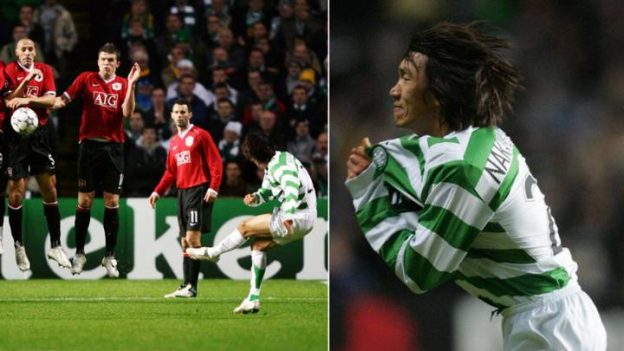
REWIND – Celtic v Man Utd.- 21 Nov 2006- Lights, Cameras & A Naka Cracka


Manchester United! The team of Alex Ferguson, and, long ago of , Matt Busby and Jimmy Delaney! The team which had resurrected itself from Munich and had won the European Cup a year after Celtic did. A team of romance and passion – not unlike Celtic themselves.

10IAR T-Shirt / Black

Meetings between the two had been scarce – Celtic had beaten them in the Coronation Cup of 1953, and in a famous friendly in 1966 at the start of the great season. But there was Pat Crerand, who could have been one of the greatest Celts of them all had he not come at the wrong time, when things were so bad that he was easily seduced away to Manchester United to the distress of everyone at Celtic Park.

All these things counted as nothing in 2006. This was the fifth game of the section. Celtic had lost the first game 3-2 at Old Trafford, a respectable but disappointing defeat. They had then beaten Copenhagen and Benfica at Celtic Park, but had then obeyed the prevailing law of the time that Celtic were obliged to blow up away from home in Europe. 3-0 at Celtic Park, was tragically balanced 0-3 in Lisbon, a city with happier memories.

Domestically, Celtic were doing well enough, the only blot on the copybook being the failure to beat Falkirk in the League Cup and the consequent defeat in the most heart breaking of circumstances – a penalty shoot-out. Celtic Park was, hardly surprisingly, sold out for the visit of Manchester United weeks before the event, and the crowd saw a good first half, although most honest Celtic supporters were prepared to admit that Manchester United played the slicker football. But Artur Boruc in the goal was in fine form, and the English team didn’t score.

More than 90 Minutes Celtic Ezine Quarterly Digital Subscription

It was much of the same in the second half, except if anything Celtic were beginning to take more of a grip of the game. It looked more and more like a 0-0 draw until well within the last 10 minutes Jiri Jarosik, a man who tended to be kept for European rather than domestic games, earned Celtic a free kick. It was more of a fall than a tackle, let’s say, but the Spanish referee bought it. It was about 35 yards from the goal, slightly to the right. It did not look like an obvious danger, but Celtic had a special free kick expert in Shunsuke Nakamura with an astonishing ability to judge his free kicks to perfection, and this was what he did here, lifting the ball over the wall and managing to get the ball to dip just under the bar.

The heaving masses of Parkhead had still more drama before the end. The Spanish referee awarded United a penalty. Saha took it, but Artur Boruc saved it. It was delirium piled on top of delirium, and the full time whistle came with Celtic winning 1-0 – enough to qualify Celtic, even though not everyone worked that out at the time, and even though Celtic went on to obey once again the rule that says you must lose in Europe away from home, this time in Copenhagen although admittedly in a meaningless fixture.

But Tuesday November 21 was a great European night.

Glasgow Celtic T-Shirt / Green

Born in 1948, David Potter first saw Celtic at Dens Park, Dundee in March 29. It was a 3-5 defeat, which equipped him admirably for the horrors of the early 1960’s. He had “followed” Celtic for a few years before that and recalls having been called upon to impersonate Jock Stein and receive the family silver teapot which had to do for the Scottish Cup as it was presented on April 24 1954, after he and his father had spent a nerve wracking afternoon listening to the radio!  Since then, he has “followed” every Celtic game with bated breath, and has written extensively about the club in magazines and books. His favorite team was that of 1969 (which he rates marginally better than 1967) and his favorite player was Henrik Larsson.

His ambition for Celtic is for them to keep on winning silver in Scotland and to be something in Europe once again. His other interests are cricket and drama. He is 70, a retired teacher of Classical Languages, married with three children and five grandchildren. He now travels on the Joseph Rafferty bus from Kirkcaldy. He also loves Forfar Athletic.

More than 90 Minutes Issue 109 Print Copy


Celtic Soul with Bobby Petta & Charlie Lord

Celtic Fanzine
Celtic Fanzine
Celtic Soul with Bobby Petta & Charlie Lord
Loading
/


Tune in now for Episode Number 4 Celtic Soul extended midweek Podcast as our Editor, Andrew Milne gets his thoughts on the Virtual season ticket fiasco off his chest and chats with former Celtic winger and House DJ, Bobby Petta and Belfast born, Philadelphia resident, Celtic supporter, Charlie Lord.

Celtic Soul T-Shirt | Black

Bobby chats about up growing up in Rotterdam and coming through the Feyenoord system, the infamous Celtic Christmas party in Newcastle, Racism growing up and in society. He also chats honestly and openly about his Celtic career from signing with John Barnes to playing his finest football both domestically and in Europe under Martin O’Neill, his love of House music and his many injuries.

Charlie chats about his experiences in America for the last 33 years after leaving his hometown Belfast, following Celtic from a far, getting home to see his Dad and Celtic. He also chats about the current political and social unrest in the US after the murder of George Floyd and his dislike of Donald Trump.

The podcast is available to download from all major Podcast platforms including Apple, Spotify, iTunes and Acast etc. or from celticfanzine.com

More than 90 Minutes Issue 109 Print Copy

Celtic Dynasty – The Mighty McStay’s


A pair of brothers winning Scottish Cup medals is no unusual. When they do it three times, it becomes rather noticeable, and when sixty years later, their great-nephews do the same thing, then everyone really has to sit up and take notice. But this is only one of the remarkable achievements of the McStay dynasty.

Celtic Soul T-Shirt | Black

A total of four McStays have played for Celtic, two brothers in the 1920s who were greatuncles of the two brothers who played in the 1980s. On four occasions – 1923, 1925, 1927 and 1985 two brothers McStay won Scottish Cup medals. Willie and Jimmy played in the 1920s and Willie and Paul played in the 1980s. Jimmy,of course, was the manager during the war years, and Willie junior had a career in management as well, although not for Celtic.

Sometimes called “the tank” (he had served in the Great War) because of his rugged defending, Willie McStay senior (sometimes written McStey in newspaper reports and certainly pronounced by the fans as if it rhymed with the vowel in “mighty”, hence the frequent headlines of “mighty McStey”) was equally at home anywhere in the defence – right back, left back, right half or centre half, although he always said that left back was his favourite position. He was also an inspirational captain, a brilliant tactician and a reliable taker of penalty kicks.

He made his debut on the opening day of the 1916/17 season and held his place in that very fine side which lost only on the penultimate League game and conceded only 19 goals all season – something that did a great deal to cheer supporters up in the face of grim news elsewhere. He then took part in the latter stages of the war, but came back in time to win a Scottish League medal in 1919/20 and to dominate Celtic’s defence throughout the decade of the 1920s.

Quarterly Magazine Subscriptions

While other players like Gilchrist, Cassidy, Cringan and McInally threw tantrums and caused trouble, McStay remained like a rock to rally players and supporters. He was not immune to disaffection, however, nor the “insidious effects of socialism”, and history has not been kind to him in terms of why he was not in the team that lost the Glasgow Charity Cup semi final against Rangers in 1923. (He was apparently in the USA considering a career there.) But fortunately, he returned to Celtic.

An intelligent and well-read, gentle, urbane man, Willie realised in 1925 that Rangers were a better team, but before the famous semi final, concocted with Patsy Gallacher the plan that defeated them 5-0, withdrawing totally into defence for the first half of the game and then hitting them hard in the second. He had the ability to nurture young vulnerable players like Connolly, Thomson and McGrory, and it is difficult to overstate Willie’s contribution to the cause throughout the difficult decade of the 1920s.

He played equally well for Scotland, latterly as captain. He played in the side that beat England 2-0 at Hampden in 1925 when Scotland won the treble, and was captain a year later when they won 1-0 at Manchester. In 1927, however, he made the tactless remark about how Scotland’s defeat was all due to his full back partner Bob Thomson of Falkirk – something that Falkirk people never forgave him for.

More than 90 Minutes Celtic Ezine Quarterly Digital Subscription

He was 35 when he left Celtic in 1929 after over a decade of consistent service. He subsequently had a short time with Hearts then dabbled in Irish football before retiring to his Lanarkshire home and his passion for dogs. He died in 1960.

History tends to confuse Jimmy McStay with his elder brother Willie. They were both defenders, frequently played in the same team, winning Scottish Cup medals together three times in the 1920s, but whereas it was generally agreed that Willie was the better player (he was capped for Scotland 13 times whereas Jimmy’s only International honours were for the Scottish League), Jimmy was possibly the better captain.

He took over from Willie as captain in 1929, and it was his fortune to lead the team in the tempestuous year of 1931 with the epic Scottish Cup Final win over Motherwell, the ground-breaking tour of North America and the tragic events of the death of John Thomson. McStay earned great respect and admiration from everyone for the dignified way in which he led the club during the traumatic aftermath of that event. Further tragedy would of course visit the club when Peter Scarff took ill and eventually died of tuberculosis.

Ghirls Celtic Soul T-Shirt


A trifle slow on the ground, he was imperious in the air and had tremendous passing ability. He was an attack minded centre-half in the tradition of Willie Loney whom he admired so much, and possibly Celtic lost rather too many goals because of his commitment to this role, but his greatest contribution to the club was in his inspirational leadership, so often being the voice of Maley on the field, and being able to bring out the best in key players like Peter Wilson, Alec Thomson and of course the goalscoring machine Jimmy McGrory.

He won five Scottish Cup medals in all, but only one Scottish League medal (in 1926 before he became captain). He was disappointed in this, but he never gave less than his best for his beloved Celtic. He went on to play for Hamilton Accies in 1934, and after managing Alloa immediately before the Second World War, became Maley’s successor in January 1940. In this, he was was no great success, but the times were by no means easy in war-time and the Celtic Board seemed to lack any great commitment to gaining the success that would have meant so much to their support.But Jimmy remained a great Celt until his death on Hogmanay 1973.

Paul McStay was generally recognised as being one of the best players of his day. A succession of Scotland team managers certainly thought that, for he was capped 76 times, and his paltry collection of medals (disproportionately low in comparison with his playing ability) can be explained by the undeniable fact that he came at a bad time of internal political strife and team managers who were visibly not of the Maley or Stein mould. Yet the fact that he is linked with Jimmy McGrory in a supporters’ song about Willie Maley, really says it all!

15 Digitals Editions including latest issue 109

The best of these Managers, Billy McNeill gave him his chance in early 1982. Paul was a creative midfield player with great passing ability, an eye for goal and a clear desire to do well for the club that he loved and never left, however hard the media tried to persuade him to go.

He had first come to the world’s attention for the Scottish Schoolboys when they beat their English counterparts at Wembley in 1980, and, unlike a few of his contemporaries, Paul did live up to his promise, looking particularly good in 1982 when he very soon established himself as one of the best players in the country. But the Nicholas fiasco of 1983 and the departure of McNeill soon after gave McStay his first taste of the problems that would beset Celtic for most of his career, namely political instability, power seeking and the club in the hands of people who knew little about football and even less about what the club meant to so many people.

Paul’s best season was of course the Centenary Season of 1987/88 when he played his full part in the glories that unfolded, but that was short-lived and after many heartbreaks, especially after he became captain in 1990, he may have thought of leaving the club in 1992, on one famous occasion at the end of the season throwing his shirt into the Jungle.

More than 90 Minutes Celtic Ezine Annual Digital Subscription

But he didn’t go. Although he was one of the more stable and reliable figures in the chaos of 1993 and 1994, his form was never the same again, even after things stabilised under McCann. He had the misfortune to miss a penalty in the awful League Cup final shoot-out of 1994, but captained the side to the Scottish Cup in 1995 against Airdrie.

Paul’s problem was that he was not naturally aggressive nor a glory-hunter. Possibly he lacked some of the “devil” that other players of commensurate ability, like Jim Baxter or Denis Law had, but he still brought to the game some fine play. Even in the days when Celtic played badly, supporters could rely on at least a flash of genius from Paul McStay. He limped off the field at Stark’s Park, Kirkcaldy in April 1997 and disappeared out of the game altogether. He now lives in Sydney, Australia.

Willie McStay junior was a good full back who won a Scottish Cup medal in 1985 and a League medal in 1986. He managed a few teams like Sligo Rovers and Ross County and was a coach at Celtic Park. His best game was probably that epic day at Love Street in 1986 when Celtic played out of their skins to beat St Mirren while waiting for the really good news from Albert Kidd at Dens Park.

Annual Magazine Subscription

Born in 1948, David Potter first saw Celtic at Dens Park, Dundee in March 29. It was a 3-5 defeat, which equipped him admirably for the horrors of the early 1960’s. He had “followed” Celtic for a few years before that and recalls having been called upon to impersonate Jock Stein and receive the family silver teapot which had to do for the Scottish Cup as it was presented on April 24 1954, after he and his father had spent a nerve wracking afternoon listening to the radio!  Since then, he has “followed” every Celtic game with bated breath, and has written extensively about the club in magazines and books. His favorite team was that of 1969 (which he rates marginally better than 1967) and his favorite player was Henrik Larsson.

His ambition for Celtic is for them to keep on winning silver in Scotland and to be something in Europe once again. His other interests are cricket and drama. He is 70, a retired teacher of Classical Languages, married with three children and five grandchildren. He now travels on the Joseph Rafferty bus from Kirkcaldy. He also loves Forfar Athletic.

More than 90 Minutes Issue 109 Print Copy


Scottish Cup Final – The Agony of 1984


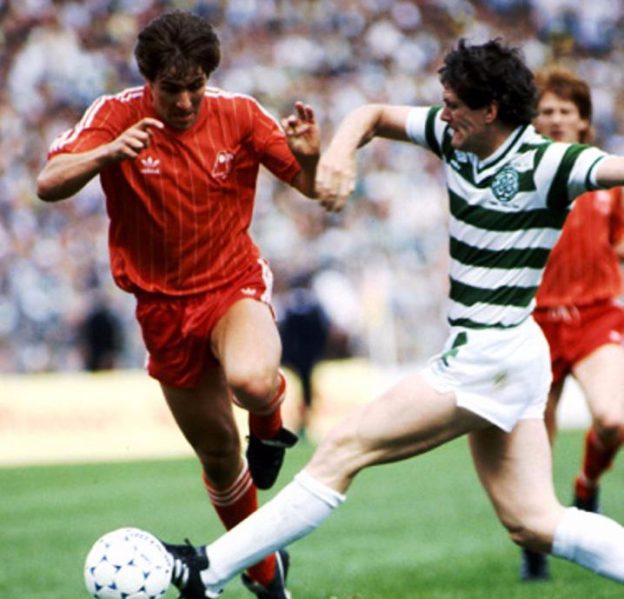
It was the BBC Scotland programme on Lockdown TV on May 15 2020 about Aberdeen that brought it all back. I refer to the Scottish Cup Final of May 19 1984. I recall I took it very badly at the time, and time has not really healed this particular wound.

15 Digitals Editions including latest issue 109

In 1984, it has to be admitted, Aberdeen were a good side and over the season, better than Celtic. They had deservedly won the Scottish League thanks to a piece of serendipity whereby a good Manager coincided with an oil boom. The city was rich, their Manager knew how to run a football club and knew how to buy well, the Directors supported him and the crowds came back to Pittodrie to see a team which won the Scottish League in 1980 and 1984, the Scottish Cup in 1982 and 1983 and most importantly the European Cup Winners’ Cup in 1983 beating, of all teams, Real Madrid in the final in Gothenburg.

And where were Celtic in 1984? Not so good. The loss of Charlie Nicholas and Billy McNeill in summer 1983 had not really been recovered from, and questions were beginning to be asked about Manager Davie Hay. We had had a poor League Cup final in March, losing to Rangers in extra time in a game dominated by penalties, and we really needed to win the Scottish Cup. There were good players – McGrain, Aitken, Burns, MacLeod and McStay, for example, would hold their own in most footballing circles – but Celtic really needed to bring home the bacon sooner rather than later. The fans were getting edgy, and attendances were beginning to fall. And yet, Celtic were not really a poor side.

The weather was good and hopes were high, possibly unrealistically so, as 60,000 turned up at sunny Hampden. The Celtic parts of the ground were crowded, but there were a few noticeable open spaces at the Aberdeen end. Morning newspapers had favoured Aberdeen, but no-one writes off Celtic on Cup final day. Celtic started kicking off toward their own supporters, and the game was even. The challenges were meaty, as one might expect, but well handled by veteran referee Bob Valentine of Dundee, the very man who had awarded the controversial hand ball penalty for Celtic v Rangers in the Scottish Cup final of 1977, seven years ago.

Celtic Soul T-Shirt | Black

Aberdeen scored first. TV replays would tend to indicate at least two things wrong with the goal – a push in the build-up and Eric Black, looking just a wee bit offside. But the goal was given, and was not necessarily looked upon as fatal, for it was early enough in the first half, and Celtic were not playing at all badly.

But then came the moment that defined this Cup final. Roy Aitken tackled Mark McGhee. Those who supported Celtic thought a yellow card was sufficient. Those who supported Aberdeen wanted red. Neutral commentator Archie McPherson on BBC TV sided with the yellow brigade, but sadly Mr Valentine, the compositor with DC Thomson in Dundee, flashed a red card. Possibly, he was still irked at being called “Bob Vatican” by the Rangers supporters in 1977, but he made his judgement – and that was what he was paid to do.

What remains still unacceptable (and an awful lot of water has now passed under the bridge!) was the attitude of Mark McGhee and Gordon Strachan. McGhee stayed down – and then recovered to score the extra time winner! And Strachan was nothing other than a despicable little stirrer who played a major part in getting a fellow professional sent off. These two gentlemen, as we know, came to Celtic Park in later years, to play an important, even perhaps a glorious, part in Celtic history. It took me, however, a long time to accept them – and I was not the only one. Even more ironically, Roy Aitken went to Aberdeen, became their Manager, and oversaw them losing in the Scottish Cup to Stenhousemuir!

Annual Magazine Subscription

But the real heroes in this Cup Final were Celtic. With 10 men, they played some of the best football the fans had seen for years, and with Roy still on board, would surely have won the game comfortably. As it was, the 10 men equalised late in the game through Paul McStay, and had Graeme Sinclair got a little more power behind a shot soon after that, they would surely have won – and deservedly. It would have been the greatest Scottish Cup final triumph of them all – and that is saying something! Willie Miller, Aberdeen’s captain was honest enough to concede that Celtic were good in the second half, and Sunday’s Press more or less unanimously agreed. Celtic have won Scottish Cups playing a lot worse than they did that agonising day of May 19 1984. Extra time however meant that 11 beat 10, and how hard it was to reconcile McGhee’s charge up the field with his arm outstretched and fist clenched in triumph with his apparent serious injury when Aitken had brought him down less than an hour previously!

1984 was a painful summer, but it is, I suppose, now hard to be jealous of Aberdeen whose supporters have had far more than their fair share of heartbreak, particularly at the hands of Celtic. They are, in the main, a decent bunch of people, rightly proud of the Ferguson years, but rightly puzzled about why, in spite of multiple visits to Hampden, they have won only one honour in the 21st century! And that was after a penalty shoot-out against Inverness at, funnily enough, Celtic Park!

But oh, the agony of 1984!

More than 90 Minutes Celtic Ezine Annual Digital Subscription

Born in 1948, David Potter first saw Celtic at Dens Park, Dundee in March 29. It was a 3-5 defeat, which equipped him admirably for the horrors of the early 1960’s. He had “followed” Celtic for a few years before that and recalls having been called upon to impersonate Jock Stein and receive the family silver teapot which had to do for the Scottish Cup as it was presented on April 24 1954, after he and his father had spent a nerve wracking afternoon listening to the radio!  Since then, he has “followed” every Celtic game with bated breath, and has written extensively about the club in magazines and books. His favorite team was that of 1969 (which he rates marginally better than 1967) and his favorite player was Henrik Larsson.

His ambition for Celtic is for them to keep on winning silver in Scotland and to be something in Europe once again. His other interests are cricket and drama. He is 70, a retired teacher of Classical Languages, married with three children and five grandchildren. He now travels on the Joseph Rafferty bus from Kirkcaldy. He also loves Forfar Athletic.


More than 90 Minutes Issue 109 Print Copy

The deeper meaning for the Irish diaspora in Scotland behind Celtic’s 1967 win in Lisbon


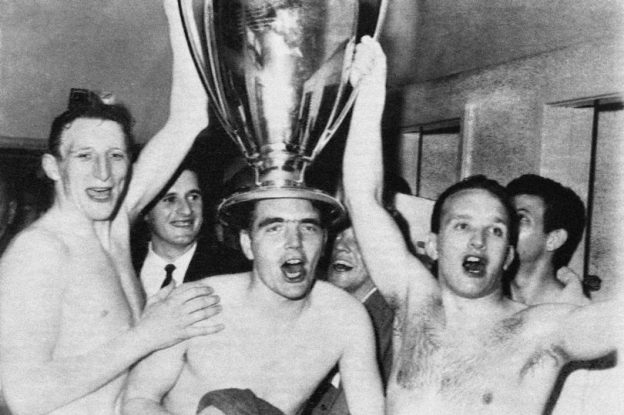
On the 25th May 1967 in the Portuguese capital Lisbon, Celtic Football Club defeated Internazionale from Milan 2-1 to become the first club from Britain and from northern Europe to win the European Cup. By 2019 barely twenty-two clubs had managed to win this most prestigious football trophy. However, Celtic’s win originated from much more modest and humble beginnings than any other club to achieve this success.

15 Digitals Editions including latest issue 109

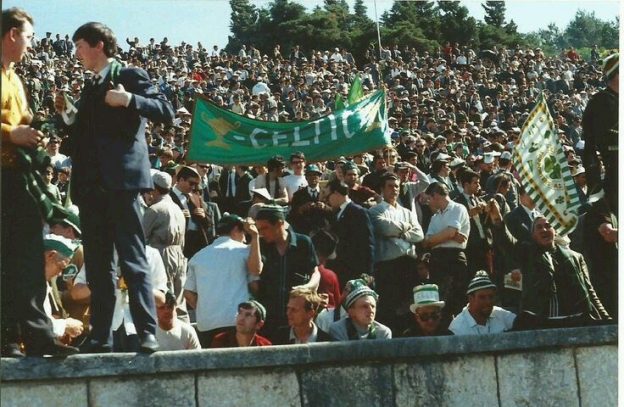
Despite Celtic’s win being reported widely and documented regularly through the years, the overwhelming majority of such discourse has considerably overlooked the magnitude and iconographic significance of this defining socio-cultural moment.  15,000 supporters, mainly from Scotland, but also from amongst the wider Irish descended diaspora in North America and elsewhere, travelled to watch their team in the final.

One popular historian records a revealing but passing comment on how so many of the Celtic support attended the celebration of Catholic Mass on the day of the final. Apart from this reference to Catholic Celtic supporters attending Mass (a few also visited the Marian Shrine at Fatima en route) little of this account distinguishes Celtic’s win from those of other sides from Britain during the following decades; Manchester United, Aston Villa, Nottingham Forrest and others.  Despite all the histories about the club’s win, the iconic status claimed and presumed is rarely explored and articulated. That is, the deep and profound impact this victory represents for many Celtic supporters: indeed, the substantially deep and profound aspects of the victory are conspicuous by their absence.

One contemporary and much lauded account of Celtic’s European Cup win justifiably describes Celtic’s win as ‘absolutely fantastic’.  However, the iconic nature of the win as a defining moment of socio-cultural significance is massively reduced by such underwhelming language and lack of linkage and connection with the things that make this success truly ‘special’ and something beyond the sports field.

Celtic Soul T-Shirt | Black

From the embers of colonialism, mass starvation and Irish immigration from Ireland to Scotland flickered the flame of a diaspora negotiating and forming its identity: and from 1888 until today Celtic Football Club has been one of their most revered totems.  Fifty years after the event, the enormity of Celtic’s achievement was recalled by historian Professor Tom Devine who encapsulated the extraordinary significance of the win in Lisbon for Catholics of Irish immigrant descent in Scotland, suggesting that Lisbon 1967 represented:

a key factor in the long story of the emancipation of the Catholic Irish in this country [Scotland]…… in terms of signal events, the Lisbon Lions victory probably stands alongside the visit of Pope John Paul II in 1982.  

Celtic’s origins begin with the cataclysmic mass death dealing Great Starvation (An Gorta Mor) in Ireland, when millions of people died or were forced to flee a colonised island. One of this event’s main consequences for Scotland was that Irish Catholic immigration led to the foundation, development and establishment of Celtic FC. The main purpose in the club’s formation was explained in a circular issued in January 1888:

More than 90 Minutes Celtic Ezine Quarterly Digital Subscription

The main object of the club is to supply the East End conferences of the St Vincent de Paul Society with the funds for the maintenance of the ‘dinner tables’ of our needy children in the missions of St Mary’s, Sacred Heart and St Michael’s. Many cases of sheer poverty are left unaided through lack of means. It is therefore with this object that we have set afloat the ‘Celtic’.

While not a Catholic football club, without Catholics, Catholicism and the Catholic Church in Scotland, there would be no Celtic Football Club. This fact is fundamental and pivotal to understanding the club’s origins, appeal, evolution, resilience and identities: and also in terms of understanding Devine’s aforementioned comment regarding Lisbon 1967 representing a defining moment in the journey towards the emancipation of Catholics of Irish descent in Scotland. Ex-Celtic footballer and manager Tommy Burns’, commented that Celtic footballers had to remember that ‘it’s more than just a football team they’re playing for. They’re playing for a cause and a people’.

For Celtic and its supporters 1967 has become a moment when the underdogs in Scottish society became the most successful underdogs on the field of play.  Some of the impact and meaning of Celtic’s victory in 1967 was expressed by supporters and others during its 50 celebration. One said:

Quarterly Magazine Subscriptions

It was the best week of my short life.  I made my Confession on the 19th, my Holy Communion on the 20th, my Confirmation on the 24th and Celtic won the European Cup on the 25th.  I was the centre of the world that week.  When Tommy Gemmell scored the equaliser my two big brothers held me up and waived me about.  Could life get any better?

Another spoke of his encounters while attending the game in Lisbon.

What I remember was I kept meeting old school friends (I had left [school] only the year before).  As most of us were Catholics and it was a holiday of obligation we headed for a church. There were a few old ladies in black, a few rich people with seats inside the alter area, and masses of Celtic fans with scarves and banners.  The locals were totally bemused.

One supporter who attended the match said, we were “no longer afraid to stand up and be counted”.  Ex-Celtic players and former Lisbon Lion John Fallon stated: “we changed a lot of attitudes for the good. We boosted the Catholics and the Irish”. Another fan said, “They were our heroes in a way that Muhammad Ali might be for black guys in America”.   In 2017 a journalist added her own gloss while remembering the moment:

Their achievement was a powerful beacon of achievement for an immigrant community that had been forced to deal with sectarianism and political marginalisation in Scotland’

Ghirls Celtic Soul T-Shirt

Of course, numerous football fans celebrated Celtic’s win in 1967 and people from non-Catholic and non-Irish backgrounds have always supported Celtic: they are and always will be the ‘Celtic Minded’. Nevertheless, what is certain is that Celtic’s European Cup victory loses its more meaningful significance unless examined in close relation to the history of the multi-generational Irish community in Scotland. To paraphrase C R James, when Celtic triumphed as European champions on what other occasion was there ever – among the Irish diaspora in Scotland at least – such enthusiasm, such an unforced sense of community, of the universal merged in a team of eleven (local) sportsmen or sportswomen? Celtic’s 1967 victory is not merely the story of a great sporting accomplishment – as extraordinary as it was and remains – it was a landmark and iconic moment in the social and cultural history of a country (Scotland) and a people (Irish-Catholic diaspora) within that country.

Joseph M Bradley is editor of Celtic Minded 4, Argyll Publishing, Available at Celtic Superstores & Amazon.

More than 90 Minutes Issue 109 Print Copy


Celtic Season Tickets – A Virtual tale of Renewals & Refunds


As Celtic fans scratch their heads about virtual season books for those who renew their actual season books, information is still a little tin on the ground for fans. Celtic have however announced they will be engaging with Sunset & Vine a production company who produce BT’s Sport’s Europa League Coverage and SPFL to produce the Celtic match day experience behind closed doors while we wait to take our seats in the stadium at a later date. Chris Sutton in your living room would be an improvement on looking at Kris Boyd. I think we can all agree on that one.

15 Digitals Editions including latest issue 109

The season book refunds have become a bit of a controversial debate topic among Celtic fans during lockdown. Celtic rightly offered fans a refund. Some decided to take to social media to say they wouldn’t take a refund, others said they would and others said they would and donate the money to charity.

What ever a fan decides to do is their own business and they should not be judged by anyone else. Financial circumstances may dictate what you do or personal dealings with the club in the past over tickets.

As I said Celtic were right to offer a refund but they have gone about it the wrong way, we live in a digital age. You should have been able to click a link, import your details and receive your refund in a matter of a minute or two and it would not take up so many wasted hours for the hard working Celtic ticket office staff and I’m sure the long suffering Celtic supporters liaison officer,  JP Taylor is inundated with correspondents.

Celtic Soul T-Shirt | Black

Instead you had to print off a form (mobile smart phones have almost done away with printers in homes and most work places were closed to print off the form), and post it back to Celtic (go to the expense of buying a stamp/envelope when it could have been emailed back, note Celtic did not go to the expense of the postal route yet expected the fans to) and for the inconvenience fans will receive a cheque for which a bank fee may apply for lodging the cheque after having the pleasure of queuing in a bank and if you live outside the UK you will have to pay a currency conversion fee when a direct transfer into your account would have been easier. A win for the banks but a yellow card from a section of the fans to the Celtic board room.

Was the system set up to make it as hard as possible for Celtic fans to reclaim the refund? or are the powers that be so far removed from the average Celtic fan on the street, I hope those who came up with this repayment system learn from this mini fiasco.

So where does that leave us now, Celtic fans may have already a subscription to Sky Sports (almost all Celtic away games will be live on Sky and the odd big home game, they may have a subscription to Celtic TV and some households will have multiple season book holders in the house so will season ticket holders be offered a part refund next season for the games held behind closed doors  but broadcast on the virtual season ticket stream into your home? And if so will Celtic fans have to go through the same old fashioned method for a refund?

More than 90 Minutes Celtic Ezine Quarterly Digital Subscription

In summing up I think that those running our great club have scored an own goal but hopefully they will have learned lessons from this. Hopefully we can get JP or a representative from the club to come onto the Celtic Soul Podcast in the coming weeks to clarify the questions posed above.

Hopefully any fans who lost their jobs during the lock down can get back working soon and we can all get back to Celtic Park soon to cheer on the Bhoys to 10IAR.

Andrew started More than 90 Minutes in 2001, he is a former newspaper columnist with the Daily Ireland and the man behind celticfanzine.com. He is host of  the Celtic Soul Podcast & Celtic AM pre-match events at Malone’s in Glasgow on match days and follows Celtic Home & Away. He is a season ticket holder for Celtic FC and the Republic of Ireland. He is also P.R.O. of St. Margaret’s CSC, a member of the Celtic Trust and the Celtic Graves Association.

More than 90 Minutes Issue 109 Print Copy