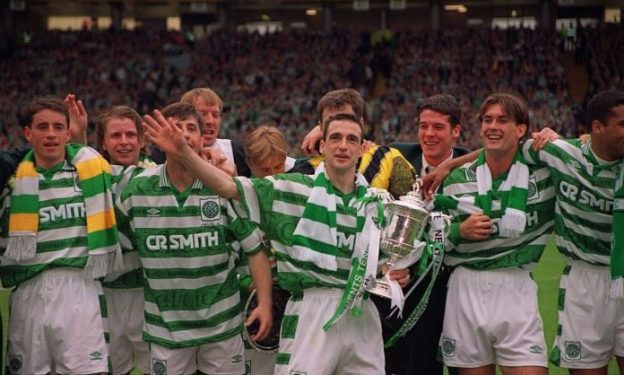
Celtic AM returns after a year with Andrew back in the hosts seat with Rudi Vata, Eddie Toner, David Potter and a few familiar faces joining him before Celtic v Falkirk.
If you would like to support our Independent Celtic Fan Media Platform you can become a Member, Subscribe, Buy or Donate for the Price of a Pint. Your Support helps us continue to produce Daily News & Articles, Weekly Newsletter, Weekly Podcasts, Monthly Fanzine, Video Content & Live Shows
If you would like to support our Independent Celtic Fan Media Platform you can become a Member, Subscribe, Buy or Donate for the Price of a Pint. Your Support helps us continue to produce Daily News & Articles, Weekly Newsletter, Weekly Podcasts, Monthly Fanzine, Video Content & Live Shows
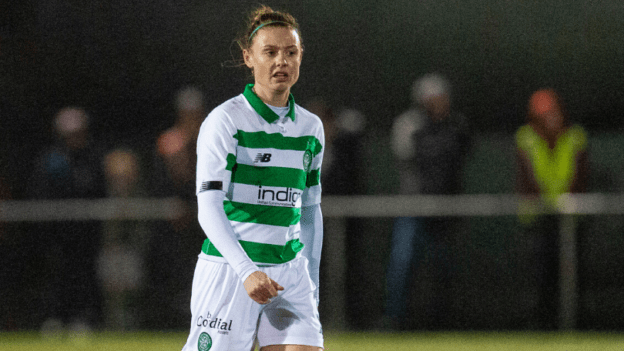
Jodie Bartle Celtic FC talks Mental Health ahead of the restart to the season against Glasgow City FC on Sunday KO 16.10 coverage starts at 4pm on BBC Alba
If you would like to support our Independent Celtic Fan Media Platform you can become a Member, Subscribe, Buy or Donate for the Price of a Pint. Your Support helps us continue to produce Daily News & Articles, Weekly Newsletter, Weekly Podcasts, Monthly Fanzine, Video Content & Live Shows
This weekend sees a return of competitive football for Celtic as we look to defend the Scottish Cup for a 5th season in a row.
The last couple of months of another wise abysmal season could show signs of recovery as we look to regain the title from those across the city and start our Champion’s League qualification journey in July. Retaining the cup would go a small way to getting fans back on side.
However, if a new management set up was to be in place for much of a cup run, it would give them a chance to look over the players that are likely to remain next year in some competitive action rather than the glorified friendlies we have to play in the league.
Rumours have intensified since yesterday that Eddie Howe is the new man, he has been my first choice all along, so I certainly would be happy with that. Whether Howe comes as well as a Director of Football remains to be seen. If they put Howe in charge now rather than end of the season then a cup win would be a great start to his management career in Glasgow.
This year’s cup run kicks off against League One leaders Falkirk, who are four point ahead of Cove and look set for a quick return to the Championship under the co-management team of David McCracken and Lee Miller. They have recently returned to action after all football under the Championship level was postponed, since returning they beat Forfar 2-0 and recorded a 1-1 draw with Dumbarton. They are sitting top of League One with a record of W8, D4, L2 and have 28 points.
Hopefully with moves behind the scenes likely to happen that the players put a bit more effort in than we have seen this season and we should see a comfortable victory.
Mick Kane hails from Glasgow. He has been hooked on Celtic since he went to his first game when he was 7. Celtic beat Hamilton 8-3 at Celtic Park on the 3rd of January 1987. His favourite player at the time, Brian McClair scored four goals.
He started going regular as a 16 year old when Celtic played at Hampden for the season, being a Southsider it meant a short train journey to get to Hampden. From then he has had a season ticket travelled around Europe for games as Celtic became the dominant force in Scottish football again. A nice change from growing up during Rangers run to 9 in a row.
If you would like to support our Independent Celtic Fan Media Platform you can become a Member, Subscribe, Buy or Donate for the Price of a Pint. Your Support helps us continue to produce Daily News & Articles, Weekly Newsletter, Weekly Podcasts, Monthly Fanzine, Video Content & Live Shows
It is true that Willie Maley was the “Man Who Made Celtic”, but Maley was lucky in that he had around him loads of men who helped him in the beginning of this awesome tradition. James Kelly was a fine defender, for example, and John Glass was a great administrator off the field, but the man who was most responsible for the launching of Celtic as an attacking force, playing the game as it was meant to be played and scoring plenty of goals was Celtic’s first famous marksman – Sandy McMahon.
Celtic have always been famous for their goalscoring abilities – and great Celtic teams have always been blessed with great goalscorers. Three super-heroes immediately spring to mind in Jimmy Quinn, Jimmy McGrory and Henrik Larsson. There are others like Jimmy “Sniper” McColl, Joe Cassidy, the McPhail brothers, Dixie Deans and (possibly) Jan Vennegoor of Hesselink, but the man who started it all was Sandy McMahon.
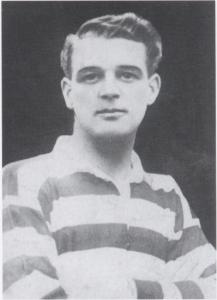
Yet Sandy does not fit the popular image of a prolific sharpshooter. Photographs show a moustachioed, magisterial Victorian gentleman with a kindly but perhaps boring expression, not at all the aggressive, competitive demeanour of other strikers of that (or indeed any) age. But appearances are deceptive. Rather like Clement Attlee, the unlikely-looking Labour Prime Minister who was responsible for the social revolution of the late 1940s, what one saw was not necessarily what one got.
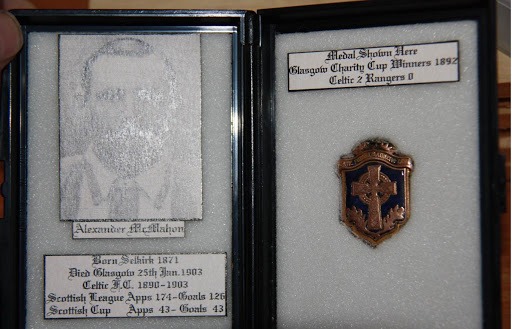
Not a great deal is known of Sandy’s life outside football. Tradition has it that he was born in Selkirk in 1871, but the exact day of his birth has been hard to trace. On the other hand there was an Alexander McMahon born in Dundee in 1871, the son of the licensees of a tavern. Is this perhaps our Sandy? Certainly the Irish had arrived in strength in Dundee throughout the 1850s and 1860s, and there are a few local indications in Dundee and Angus folklore that Sandy might have sprung from that source, but it is now almost certain that Sandy hailed from Selkirk,
It matters little. He played his early football in the late 1880s in Edinburgh for teams like Harp Juveniles, Woodburn, Leith Harp and the great Hibernian football club themselves. Hibernian were, of course, the natural club to which the young Sandy would have gravitated. Avowedly and even exclusively Irish, the Hibernian team won the Scottish Cup in 1887 to the great joy of the large Irish community. The only problem with that (as far as Hibernian were concerned) was that it planted a seed among Irishmen in Glasgow that they, too, could form an Irish team, one that would supplant and take over from the Edinburgh Hibs. This one would be called the Celtic.
Sandy had been with Hibernian – indeed, he had been a reserve in their Scottish Cup victory in February 1887 – then moved for a brief and unhappy time to a team called Darlington St.Augustine’s, before returning to Edinburgh in September 1888. He played for Hibernian for two years but then in December 1890 he joined Celtic. Hibs were at that time imploding as a result of the rise of this new Irish team in Glasgow, and they also had major difficulties with their ground. Legally, there was no problem about McMahon jumping ship like this without any indication of a transfer fee because Scottish football until 1893 was, at least in theory, amateur.
It does, however, stretch our belief more than somewhat to say that McMahon received no money from this young and ambitious Glasgow team. Money would indeed have been a strong factor, but as potent a pull, one would imagine, would have been the clear indications that this Celtic side, which from the start and (unlike Hibernian) would welcome Catholics and Protestants alike, were the one that was going to win trophies. Indeed, they had already been in the Scottish Cup final in 1889.
His debut was in a friendly against Dumbarton at Old Celtic Park on New Year’s Day 1891. Dumbarton had beaten Celtic ten days previously to put them out of the Scottish Cup, and would go on to share the Scottish League that season with Rangers, but on this day they were held to a 1-1 draw. The Glasgow Observer newspaper, sometimes called the “Catholic Observer” and with no real claims to objectivity as far as Celtic were concerned even in the early days, was satisfied with the draw but described McMahon in curious terms: “Arms held high, spread out like ostrich wings, head down, back slightly bent forward, enormous feet”. It is from such slender indications of brilliance that a mighty career was to be launched.
Sandy’s competitive debut for Celtic was against Vale of Leven in Alexandria, near Dumbarton, on 24 January 1891. Sandy may or may not have been a professional, in theory or in practice, but the general amateurishness of Celtic’s approach in the early days is evidenced by the fact that a player missed his train and Celtic had no reserves available. So Sandy actually had to play left-back until the man arrived! The team lost 1-3, thereby losing what little chance they had of landing the League championship in 1891.
McMahon did not play in the club’s big success that season, namely the winning of the prestigious Glasgow Cup, but he did play sporadically at first and later regularly for the team, hitting the highlights on 5 May with four goals in a spectacular 9-1 drubbing of Vale of Leven at Old Celtic Park. He was now settled at inside-left and could interchange brilliantly with Johnny Campbell on the left wing. The passing game was, of course, the trademark of Scottish football, and he had an almost telepathic understanding with Campbell. But he was also noted for his individual play, and the coming season of 1891/92 was to indicate the arrival of Celtic’s first superstar. It would also be the first great year in the history of the club.
Celtic retained the Glasgow Cup in December and this time Sandy won a medal, scoring a goal in a 7-1 thrashing of Clyde at Cathkin, and by the turn of the year the team was going well in both the Scottish League and the Scottish Cup, with the crowd beginning to appreciate the inspired play of McMahon. In the Scottish Cup Cowlairs fell in the quarter-final and Rangers in the semi, with McMahon’s name on the scoresheet on both occasions. The Scottish Cup final was at Ibrox on 12 March against Queen’s Park, but although Celtic won 1-0, the game was declared a friendly, such were the chaotic conditions with the huge crowd. The cause? Principally the widespread enthusiasm to see the now-famous left wing combination of McMahon and Campbell.
Not only were the Celtic fans impressed by Sandy, so too were the Scotland selectors, and he found himself in his country’s team on 2 April at Ibrox. It was a sad day, however, for both Scotland and McMahon, as they were engulfed 1-4 by a strong England team. Sandy never got going, but as he left Ibrox that night, he knew he would be back a week later for what he hoped would be a happier occasion. This would be the replay of the Scottish Cup final.
We all know, don’t we, that the first hat-trick to be scored in a Scottish Cup final was by Jimmy Quinn in 1904, a feat emulated by Dixie Deans in 1972? But was Jimmy’s truly the first? A certain amount of evidence came to light recently to indicate that perhaps it was Sandy McMahon in 1892 who scored the first Scottish Cup final hat-trick. It is, of course, the task of the historian to evaluate evidence and to make up his mind on what is in front of him.
The disturbing (if that is the right word) evidence comes in the shape of The Scotsman’sreport of the 1892 Scottish Cup final. The game against Queen’s Park was played (after the first encounter had been declared void because of overcrowding and crowd encroachment) on 9 April 1892 and Celtic won 5-1. The edition of The Scotsman concerned is that of Monday 11 April 1892, clearly written (anonymously in the style of Victorian journalism) a matter of hours after the final whistle.
The key goal is the first one. Willie Maley, who played in the game, and all orthodox Celtic historians give this to Johnny Campbell. It was the goal which levelled the scores, as Celtic played with the wind which was blowing towards the west goal at Ibrox (i.e. towards what is now called the Broomloan Road Stand or the “Celtic End” of Ibrox). The Scotsman had this to say: “The Irishmen’s (sic) efforts were at length rewarded, as after some smart play in front of the goal, McMahon with a wonderful overhead shot, put through the first goal for his team”.
The scribe of The Scotsman then comments on the “outburst of enthusiasm from the Parkhead club’s followers” and after a short period the second goal “was put through for the Celtic from the left wing”. Curiously, he does not mention who scored it other than obliquely, but the “left wing” presumably means that Johnny Campbell scored it.
Then comes the third goal. Having praised Dan Doyle, who was “simply unpassable”, the reporter says: “McMahon (was) playing up in surprising fashion, and through his instrumentality, Baird was beaten for the third time”. This is the goal which Maley describes thus: “McMahon, indulging in one of those mazy runs – head down, arms outstretched – simply walked through the Amateurs’ defence to register the third goal”. No doubt about that one – it was Sandy McMahon who scored it and “the Celtic followers were now quite beside themselves with delight”.
The fourth came from a deflection by a defender from a James Kelly free-kick, and then Sandy McMahon scored Celtic’s fifth with a header from a corner. But was this Sandy’s second or his third? Everyone seems to agree that Sandy scored numbers three and five, but is the writer of The Scotsman right in attributing the first goal to McMahon?
On balance, probably the historian will conclude that The Scotsman’s reporter may have made a mistake, because the term “hat-trick” is not used in his summing up of McMahon’s performance. Sandy is described as “showing astonishing dash and resource which marked him out as the best of the forward line”. One would have expected “hat-trick” or even “three goals” to be mentioned.
What is certain, however, is that Scottish football was never the same again. The rejoicing in the East End of Glasgow that night was legendary. The Celtic had arrived. “Our Bhoys Have Won The Cup!” cried the urchins, the destitute and the ill-fed, as everyone swirled round the charabanc to the music of the bugles and the flutes, (Yes, flutes!) hoping to catch a glimpse of their heroes. Queen’s Park, the team of the avowed amateurs, the middle class, the rich, the privileged, had been beaten in a Scottish Cup final. The talk of Scotland was now of men like James Kelly, “Dan” (Doyle, but now simply referred to as “Dan”) and, of course, “Sandy” or “The Duke” after the French President Duc de Mac-Mahon, although some say that Sandy was being compared to The Iron Duke, the Duke of Wellington.
The impoverished Irish in Glasgow had been given a boost to their morale. They now had a standard around which they could rally. They could now hold their heads up when football was mentioned, and even if they had not previously been interested in this new thriving Scottish game, they certainly would become so now. Sneers about being Irish could now be counteracted by mention of Sandy McMahon.
But did McMahon score a hat-trick, the first ever in a Scottish Cup Final? Or did the type-setter of The Scotsman simply make a mistake with the first goal? Certainly, the writer was very definite that it was a “wonderful overhead shot”. In some ways, one hopes that The Scotsman was right. It would certainly be no slur on Jimmy Quinn or Dixie Deans to compel them to share the same spot in the Celtic Valhalla as Sandy McMahon. And what a pity Jimmy McGrory and Henrik Larsson did not emulate that mighty feat as well! McGrory scored two in the 1931 replay, and Larsson two in 2001 and 2004. How many did McMahon score in 1892?
Of more concern in 1892 was whether Celtic could do the Grand Slam and win all four Scottish trophies. For a long time they were neck and neck with Dumbarton, but lost the crucial fixture at Boghead (soon to be called “fatal Boghead” because of the amount of times Celtic and Rangers lost there) on 23 April and the League slipped away to the Sons of the Rock. But Celtic lifted their third trophy of the season when they beat Rangers 2-0 in the Glasgow Charity Cup final on 1 June. Three trophies out of four is not bad, and legend has it that a Celtic committee man, Ned McGinn, sent a telegram to the Vatican asking the Holy Father to light candles in St.Peter’s. His Holiness apparently refused, although had he seen the brilliance of Sandy McMahon, the Glasgow wags said, he would have been hard pressed to refuse canonisation.
But that same summer brought disturbing news of McMahon. He and Neil McCallum had apparently joined Nottingham Forest. Professionalism was, of course, legal in England, and McMahon was clearly neither the first nor the last to be “bought and sold for English gold”. There then occurs one of the most famous stories in Celtic mythology, namely that a group of committee men spearheaded by the energetic John Glass hastened to the Midlands and persuaded Sandy to return home. Words like “kidnap” and “coup” have been used, and we are expected to believe that the still-amateur Celtic persuaded him back for no reason other than the love of the club.
Clearly we will never establish the entire truth of this matter, but some suggestion that Celtic (illegally) offered more money than Nottingham Forest did to the homesick Sandy, and that he accepted, would not appear to be entirely wrong. Yet it is an indication of the reputation and prestige of the man that we hear stories of tables being knocked down as the raiding party rushed to the station, of someone detaining the Forest delegates while Sandy escaped, and a great reception organised by Willie Maley back in Glasgow. Such stories could only accrue to the charisma of Sandy McMahon.
Maley, who both played with and managed Sandy, said that “of speed he had little”, but such were his other attributes that this was hardly noticed. There were possibly three aspects to McMahon’s greatness. One was his goalscoring ability with both feet and head, one was his dribbling (not for nothing was he called “The Prince of Dribblers”) and the third was his telepathic understanding with left-wing partner Johnny Campbell.
Johnny was indeed lured away to England, to Aston Villa, for a couple of years (no adequate rescue operation having been arranged for him) and in his absence Sandy struggled for the want of an adequate partner, with 1897 proving a particularly low ebb in the club’s short history. Campbell and McMahon, however, remained good friends to the extent that when McMahon married Annie Devine in May 1896, Campbell returned from England to do the honours as best man. The marriage, incidentally, took place on a Tuesday. On the previous Saturday, McMahon scored as Celtic beat Rangers 6-1 in the Glasgow Charity Cup semi final and on the following Saturday he scored again as they beat Queen’s Park 2-1 in the final.
But before the departure of Campbell, the club had won the Scottish League in 1892/93 and 1893/94, also losing the Scottish Cup final in both those years. Sandy scored 11 goals in 13 League games in 1892/93 and ten in 15 in 1893/94. Twice he scored hat-tricks against Third Lanark and St Bernards, and the fans of the green-and-white vertical stripes (which Celtic wore until 1903) talked about little other than Sandy McMahon.
Celtic fans in the 1890s were small in number (but growing) and it would be some time before they extended their base beyond the East End of Glasgow. But his fame spread to other parts of Scotland as well and on 7 April 1894, it was McMahon who, on his own pitch at the recently built New Celtic Park, scored the goal that put Scotland ahead against England, only for their hopes to be cruelly denied in the last minute.
Football was a rough game in those days and Sandy, like many forwards, was prone to receive more than a little hacking from none-too-gentle opponents. He was out for a long time on several occasions, notably in the bad season of 1896/97 when Celtic finished trophyless for the first time in that decade. He was injured on 21 November 1896 as Celtic went down to Rangers in the final of the Glasgow Cup, and never reappeared that term. His supporters must have wondered whether he was finished. They might well have asked the same question about Celtic themselves. Of course, 9 January 1897 was the day that Celtic shocked Victorian Scotland by going down to Arthurlie in the Scottish Cup. It would have been hard to imagine that happening if Sandy had been on board.
McMahon’s value to the Celtic cause was underlined in the 1897/98 season. The team swept all before them in the Scottish League. They were undefeated, they drew on three occasions and won against everyone else. This included a spectacular defeat of Rangers at Ibrox on the Monday September holiday, competent victories against other challengers like Hearts and Hibs, and there was a particular relish for Clyde, who were put to the sword 6-1 and 9-1. In all of this McMahon, playing at inside-left, was a goalmaker rather than a goalscorer, supplying the ammunition for George Allan, a Celtic centre-forward whom history has curiously undervalued. Johnny Campbell, too, had returned, and was now playing at inside-right to complete a prodigious inside trio.
But things came to a shuddering halt for Celtic in the Scottish Cup when they went down to Third Lanark in late January 1898, the significant factor being the absence through injury of McMahon, and the consequent necessity to rejig the forward line. Even at this early stage of the club’s history, the Scottish Cup was considered a vital tournament. Celtic had exited two years in a row in January. On both occasions, McMahon was not playing.
All this was made good in the Scottish Cup of 1899 when Celtic beat Rangers 2-0 to lift the trophy for the second time. League form had not been good. Rangers now had a great side and went through the 1898/99 League season with a 100-per-cent record, and on both occasions that they beat Celtic, they put four goals past them. They had also defeated Celtic in the Glasgow Cup final in October, so the green-and-whites had little reason to approach the Scottish Cup final on 22 April with any degree of sanguinity. No team had ever as yet managed to win both the Scottish Cup and the Scottish League in the same season, but the smart money would have been on Rangers to do it that year.
But Celtic still had McMahon. He had scored in every round on the way to the final, including two in the quarter-final as Celtic edged past Queen’s Park 2-1. In fact, he had also scored the previous week, but the game had had to be abandoned because of “bad light”, although the cynics suspected that the light was good enough, whereas an abandonment would lead to another large gate – such was the desire to see the great Sandy McMahon, who was now talked about incessantly in the ale houses of Glasgow.
The final would be played at Second Hampden, a ground that would be called Cathkin Park when Third Lanark took it over. The Third Hampden Park would not be built until 1903, and it was probably the massive crowd at Second Hampden to see this Scottish Cup final in 1899 which persuaded Queen’s Park that another stadium was necessary. Some 25,000 turned up – a huge crowd, and possibly a record for a game other than Scotland against England. One says “possibly” because crowd counting was not necessarily an exact science at the time, and it was estimated that 40,000 attended the 1892 Scottish Cup final at Ibrox, which had to be declared a friendly because of repeated crowd encroachment. In addition, there had been several claims that season that 35,000 or 40,000 had attended a game but “attendances“, then as now, were often little other than the guess of a newspaper man.
This time the Glasgow Herald reported that the crowd was orderly and well behaved, and that although the weather was worthy of a Scottish Cup final, the standard of play was less so. Rangers had the better players (as their League form indicated) but Celtic’s defenders marked their forwards tight. By no means as tight, however, as Rangers’ notorious Nick Smith, whose coarse challenge severely disabled McMahon’s left-wing partner, Jack Bell.
Half-time came with no score, then in the early part of the second period, the game swung decisively in favour of Celtic. Rangers had a goal chalked off, allowed themselves to be flustered about it, and Celtic took the initiative. They forced a corner, then for once McMahon eluded the eager attention of the two Rangers defenders detailed to mark him and rose “like a bird” to meet the dispatch and head home brilliantly. Celtic now took charge with McMahon on song, winning balls, dribbling and “passing to a degree of excellence”. It was no surprise when Hodge added a second, although Rangers claimed offside.
The game finished with Celtic 2-0 ahead, and Rangers were sporting enough to admit that, on this occasion, their Glasgow rivals were worthy winners. Thus Celtic had won the Scottish Cup for the second time, and McMahon had earned himself another niche in the club’s history for having scored a glorious header. Of course, Sandy had had a point to make as well. He had been dropped from the Scotland team after the draw in 1894, and had felt that he was good enough to regain the spot. In 1899, two weeks before the Scottish Cup final, Scotland had lost 1-2 to England at Villa Park. McMahon still felt that he could do a job for his country.
Another Scottish Cup would come Celtic and McMahon’s way a season later. The year was 1900, and the new century was bringing in a new order to Scottish football. Rangers, having won the Scottish League in 1898/99, had done so again in 1899/1900 and were now quite clearly emerging as the rivals to Celtic. Rangers were never likely to take support away from Celtic, for Celtic’s support was firmly anchored in the Glasgow Irish, but the Ibrox club was definitely, in this respect, getting the better of Queen’s Park.
Queen’s Park had stayed amateur and refused, at first, to join the Scottish League. They were thus left behind with their middle-class support, whereas the Protestant working class turned more and more to Rangers. Sectarianism had not yet arrived to foul Scottish football, but the seeds were there.
McMahon, however, defeated both these outfits in spring 1900. The semi-final at Ibrox was drawn (another sinister and suspicious dynamic at work in those days was the tendency for Rangers and Celtic to draw Cup-ties, leading to the necessity of a replay and another big crowd!) but then in the re-match, Celtic chose to turn on the style. They defeated Rangers 4-0, with McMahon “ubiquitous, ambitious and dominant”, scoring two goals from the inside-left position.
It was a mighty forward line of Hodge, Campbell, Divers, McMahon and Bell, when they were all on song. They were on this occasion and the 32,000 fans left Celtic Park that day singing paeans of delight and clamouring for the inclusion of the whole Celtic forward line in the Scottish team for the game against England. In the event, Jack Bell and Johnny Campbell got the nod, albeit not in their normal Celtic positions, but McMahon was once again sidelined to the annoyance of the fans.
Any feelings of frustration, however, had to be tempered when Scotland played brilliantly on 7 April and beat England 4-1, with Robert McColl of Queen’s Park scoring a hat-trick. In any case McMahon had a chance to prove his point the following week in the Scottish Cup final when Queen’s Park faced Celtic at Ibrox. It was a game played in a gale blowing in from the west. McMahon scored twice in the first half as Celtic went in at half-time 3-1 up, but that was with the benefit of the wind.
Realising the necessity of keeping the ball on the ground as much as possible against the wind, McMahon was instrumental in Celtic scoring early in the second half, releasing Divers to find the net. From then on, however, it was backs to the wall, with McMahon having to play his part in defence as Queen’s pressed and pressed. They did score twice, but too late in the game to have any effect, and when Mr Walker of Kilmarnock blew for up for time, the green-and-white vertical stripes had captured their third Scottish Cup, and Sandy McMahon and Johnny Campbell had participated in all three triumphs.
This was the zenith of McMahon’s fortunes with Celtic. He was now nearly 30, and although he earned a Scotland recall against Ireland in 1901 and Wales in 1902, he never made it for the games that really mattered against England. Ireland and Wales seldom troubled Scotland in those days, and it was common practice for them to play virtually a reserve side.
Yet for all that, Sandy McMahon can claim to be part of a Scottish record. The game against Ireland at Celtic Park – it was also widely believed and scarcely denied that for games against Ireland at Celtic Park, the Scottish team was full of Celtic players for reasons of attracting a large crowd – ended up in an 11-0 win for the Scots over a woefully inadequate visiting team. This still stands as a Scottish record. Sandy scored four goals that day, as did Bob Hamilton of Rangers.
But the Celtic team were now ageing, McMahon as much as any of them. In addition, the Rangers teams of 1900/01 and 1901/02 were as good as had ever previously come from Ibrox, and Celtic also had the misfortune to lose two successive Scottish Cup finals to Hearts in 1901 and Hibs in 1902. McMahon had reason to feel ill done by on both occasions. He scored in the Hearts final – a game that Celtic would have won but for dreadful goalkeeping errors –and the Hibs final also proved to be unlucky. It was played at Celtic Park only three weeks after Glasgow had been stunned by the Ibrox disaster, in which 26 people had been killed and many more injured at the Scotland v England game. In this unfortunate atmosphere, Hibs scored the only goal of the game with a backheeler.
There would have been less justification for self-pity on New Year’s Day 1902. It was Celtic’s last game of the Scottish League campaign (the Scottish League usually finished at the turn of the year in those days) and Celtic were two points ahead of Rangers, who had a game in hand. Thus a Celtic victory would have won the League, and a draw would have guaranteed at least a play-off. Around 40,000 were at Parkhead, and Celtic, without the impressive young Jimmy Quinn, played very badly, losing 2-4. McMahon scored one of the goals, but then, infuriated by one or two eccentric decisions by the referee, Mr Nesbit of Cowdenbeath, he got himself sent off in a melee in which he seemed to push and trip the official. Celtic never recovered from this blow, and Rangers won their fourth consecutive Scottish League title when they beat St Mirren in their remaining game.
It was now becoming clear to the energetic manager, Willie Maley, that changes were required. This involved the gathering of young talent from which would emerge the mighty and virtually unchallengeable forward line of Bennett, McMenemy, Quinn, Somers and Hamilton. This meant that the old guard had to be gradually and gently pushed out the door. McMahon, in any case, missed a large part of the 1902/03 season through injury and his last big game was the dreadful Scottish Cup quarter-final against Rangers at Parkhead, when the team went down 0-3.
He finished his playing days with Partick Thistle. It was perhaps appropriate that the Celtic team changed its jersey to the horizontal hoops rather than the vertical stripes round about the time that McMahon left and the new Celtic began to take shape. Thus McMahon never wore the hoops, but he had certainly worn the stripes. He, as well as Maley and others, certainly laid the foundation for the new Celtic.
He lasted barely a year with Thistle, but then he did what so many other ex-footballers did in those days – he bought a pub. It was at 209 Great Eastern Road, not far from Celtic Park, and became know as “The Duke’s Bar”,where he proved to be a genial host. McMahon had the advantage as well of being a well-read man, who recited Shakespeare and Burns at Celtic soirees. Like so many great men and great Celts, he was not snobby, conceited or big-headed. He was proud of his achievements, but he also relished the glory of his successors, delighting for example in the goalscoring exploits of Jimmy Quinn, the wiles of Jimmy McMenemy and continuing success of his old colleague and friend Willie Maley.
He lost his wife, Annie, in March 1908 in the most tragic of circumstances, in childbirth. She was only 33, and from then on Sandy’s own life and health went downhill. Too old for war service in 1914, he found employment in the munitions industry as an iron-borer, a job he tried to combine with his interests in the licensing trade, but this did not last long. He suffered from nephritis, a chronic complaint of the kidneys, a condition which compelled his removal to the Glasgow Royal Infirmary in late 1915. It was left to Willie Maley, who had attended him assiduously, to tell the story of what happened a few days before his old friend’s death on 25 January 1916. One Sunday night at the height of a dreadful war saw the great Maley in tears as Sandy rolled back the bedclothes, pointed to his emaciated legs, bruised and scarred by many injuries sustained on the playing field. “Willie”, he said, “at least these two legs have done their bit for the Celtic”.
Born in 1948, David Potter first saw Celtic at Dens Park, Dundee in March 29. It was a 3-5 defeat, which equipped him admirably for the horrors of the early 1960’s. He had “followed” Celtic for a few years before that and recalls having been called upon to impersonate Jock Stein and receive the family silver teapot which had to do for the Scottish Cup as it was presented on April 24 1954, after he and his father had spent a nerve wracking afternoon listening to the radio! Since then, he has “followed” every Celtic game with bated breath, and has written extensively about the club in magazines and books. His favorite team was that of 1969 (which he rates marginally better than 1967) and his favorite player was Henrik Larsson.
His ambition for Celtic is for them to keep on winning silver in Scotland and to be something in Europe once again. His other interests are cricket and drama. He is 70, a retired teacher of Classical Languages, married with three children and five grandchildren. He now travels on the Joseph Rafferty bus from Kirkcaldy. He also loves Forfar Athletic.
If you would like to support our Independent Celtic Fan Media Platform you can become a Member, Subscribe, Buy or Donate for the Price of a Pint. Your Support helps us continue to produce Daily News & Articles, Weekly Newsletter, Weekly Podcasts, Monthly Fanzine, Video Content & Live Shows
Celtic Soul Podcast Episode 59 with More than 90 Minutes, Editor Andrew Milne chatting to Jacky Meehan
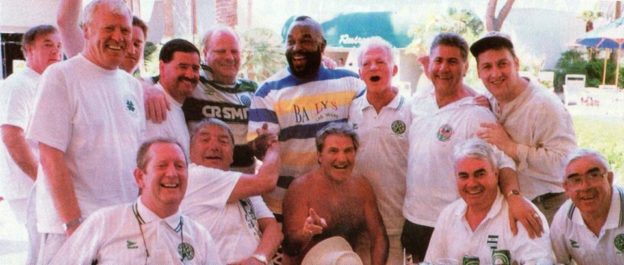
Jacky witnessed the most successful period in Celtic’s history from 1965 till 1974 in Glasgow before moving to Canada for a new life. Jacky is the former President of the North American Celtic Supporters Federation and a driving force behind the Celtic Conventions in Las Vegas.
The Bhoys haven’t spoken since they met at Easter Road a few season’s back and catch up discussing the current state of play at Celtic and look back at some great moments in Celtic history for fans on and off the park. There is plenty of laughter as Jacky looks back at growing up in Glasgow close to the ground in Bridgeton and his passion for the club shines through.
Jacky celebrated his 12th birthday watching Celtic win the 1965 Scottish Cup Final and talks about following Celtic everywhere and enjoying the first 9IAR before leaving Celtic and Glasgow behind for a new life in Canada.
He gets back every year to Glasgow to take in a few games with Seville the highlight of his many travels home. In the early days Jacky would be on the phone to his brother in Glasgow if he couldn’t get a game on the radio and his brother would keep him updated throughout the 90 minutes.
Modern technology means Jacky can now get Celtic news 24/7 but some of the lengths Celtic fans went to get to watch games in North America over the years is recalled by Jacky including hilarious Police raids and chopping down trees!
Jacky chats about how the NAFCSC came about and some of the conventions in Vegas and elsewhere throughout North America and the Celtic players who have joined them over the years. Tales from Detroit, Las Vegas and New Orleans all get told.
The NAFCSC have donated quietly for many charities including to the families of two Celtic fans murdered in Glasgow. Sometimes these donations get over looked and it is good to hear that the wishes of Brother Walfrid are still alive and well in North America.
Jacky Climbs into the Celtic Soul Time Machine and goes back to Las Vegas and also watching Bobby Murdoch his favourite player. The 1965 Scottish Cup Final, Milan in the Snow, 1989 Scottish Cup Final and Seville also get visited.
Three words sum up this conversation Family, Friends & Celtic
Andrew Milne started More than 90 Minutes in 2001. He has written for numerous publications and online about Celtic. He is a former newspaper columnist with the Daily Ireland and the man behind celticfanzine.com. He is host of the Celtic Soul Podcast & Celtic AM pre-match events at Malone’s in Glasgow on match days and follows Celtic Home & Away. He is a season ticket holder for Celtic FC and the Republic of Ireland. He is also P.R.O. of St. Margaret’s CSC, a member of the Celtic Trust and the Celtic Graves Association.
If you would like to support our Independent Celtic Fan Media Platform you can become a Member, Subscribe, Buy or Donate for the Price of a Pint. Your Support helps us continue to produce Daily News & Articles, Weekly Newsletter, Weekly Podcasts, Monthly Fanzine, Video Content & Live Shows
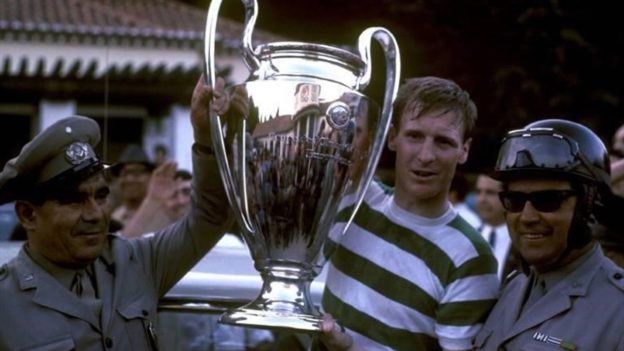
Lets go back to Lisbon, on that sunny day in May the year was 67′ and the cup was won that day as Billy stood up high there with the Cup held in his hand the name of Glasgow Celtic was heard throughout the land.
Last night we witnessed Luxembourg beat Ireland 1-0. No Celtic players were involved with Shane Duffy unable to get a place in the starting line up against the minnows of International football after being dropped for the 3-2 loss in Serbia midweek, in which Ireland performed much better than last night. The Celtic flag however was flown when the Irish under 21’s took to the pitch against Wales in a friendly with three Bhoys lining out for the boys in green.
All three players, Luca Connell, Jonathon Afolabi and captain Lee O’Connor started for Ireland. Afolabi equalised for Ireland before a Welsh own goal wrapped up the victory. All three players are out on loan learning their trade. Afolabi (Dundee) Connell (Queens Park) and O’Connor (Tranmere Rovers) lets hope that they can come back from the loan spells and force their way into the new managers plans, who ever that may be.
Ryan Christie and Callum McGregor are two players that spring to mind who benefitted greatly from loan spells. If any of the three young Irish players have the same impact as the likes of McGregor or Christie then they may just become the toast of the Gallowgate on a matchday. In the meantime they will have to work hard on loan before returning to the parent club for pre-season.
The Irish under 21 team were a bright spark in the a dark few days for Irish football as it tries to recover from years of neglect while the man in charge, John Delaney engaged in a Champagne Lifestyle blinding some fans with a few free pints on away trips while wining and dining politicians, ex players, members of the media and the odd supporter on the FAI credit card while some school children were forced to change in the pissing rain on the side of rented pitches paid for by the parents.
Delaney is gone and his last appointed manager Stephen Kenny is left to pick up the pieces after former Celtic coach, Damien Duff had enough of the FAI and left before the World Cup campaign even started and now after only two games it looks like it is over.
Andrew Milne started More than 90 Minutes in 2001. He has written for numerous publications and online about Celtic. He is a former newspaper columnist with the Daily Ireland and the man behind celticfanzine.com. He is host of the Celtic Soul Podcast & Celtic AM pre-match events at Malone’s in Glasgow on match days and follows Celtic Home & Away. He is a season ticket holder for Celtic FC and the Republic of Ireland. He is also P.R.O. of St. Margaret’s CSC, a member of the Celtic Trust and the Celtic Graves Association.
If you would like to support our Independent Celtic Fan Media Platform you can become a Member, Subscribe, Buy or Donate for the Price of a Pint. Your Support helps us continue to produce Daily News & Articles, Weekly Newsletter, Weekly Podcasts, Monthly Fanzine, Video Content & Live Shows.
In the desperate days of the 1990s, the beleaguered Celtic board appointed a front-man called Terry Cassidy who would be their spokesman for the media. The cynics said that they were hiding behind him, and in truth the man was a lightweight who had the annoying habit of answering a direct question with another question. A veteran supporter watched his television in disgust before saying that it would have been better if they had resurrected old Joe to save us.
Joe Cassidy was one of the cult heroes of the early 1920s. The times were grim in the aftermath of the Great War, with the ongoing problems in industrial relations and in Ireland, both of which affected Celtic fans intimately as everyone struggled with the problems of adapting to a new life. In many cases this happened without the breadwinner, who was lying in the fields of Flanders or who was sitting in a wheelchair, effectively a parasite in a situation where the Government was cynically indifferent to his plight.
Joe Cassidy played his part in alleviating suffering. Joe had been a soldier himself – he was called “Trooper Joe” – in the Great War and had won the Military Medal in the last few days of the conflict in November 1918, while serving with the Black Watch. Born in 1896, he had made an insignificant impact for Celtic, both before the war and, whenever he had the opportunity, during it. But in the years immediately following the Armistice, he really began to make his mark.
He was not properly demobbed until summer 1919, although while home on leave he did manage a few games in the 1918/19 season. He was an inside-left and there was brisk competition for the inside-forward positions at Celtic Park in 1919/20, with Patsy Gallacher and Jimmy McMenemy consistently and impressively brilliant. But McMenemy left for Partick Thistle, Maley having erroneously considered that he was past his best, and opportunity knocked for the charismatic young Cassidy in 1920/21.
The inside trio of Gallacher, McInally and Cassidy was a formidable one, and the team would have won the Scottish League that term had it not been for the fact that they were up against a top-class Rangers team. But they did win the Glasgow Cup and the Glasgow Charity Cup, and for Joe there was one particular occasion when he captured both the imagination and the hearts of the faithful.
It was New Year’s Day at Ibrox when Joe scored both goals in Celtic’s 2-0 victory in front of 70,000 fans. The goals were well taken and many contemporary accounts exist of the scenes in Glasgow after the game, as the horse-drawn carriages and charabancs returned from the game. The revellers were blowing bugles, roaring rebel songs and singing the praises of Sinn Fein, the Irish Republican Army, the Mayor of Cork, who had died in a hunger strike a couple of months previously – and, in the next breath, Joe Cassidy!
If Joe had not been a cult hero before, he was now. A very handsome man with a touch of shyness about him, Joe was exactly what any mother would have wanted for her daughter. He was clean-cut, kept himself fit, was a war hero and, in footballing terms, he was a perfect foil for the wilder elements of McInally and Gallacher. Being an inside-left, he did not score as many goals as he might have (22 in that season), but he was very definitely the purveyor, the hard worker, the accurate passer and the man who could occasionally bring a cheer by the odd piece of football trickery.
Only a disappointing defeat at Raith Rovers on a day towards the end of the campaign when Celtic had a few players missing (as we shall see) prevented the winning of the League, but there would be better luck for the Celts the following season. Still, Joe’s success in 1920/21, particularly his high-profile performance on New Year’s Day, earned him international recognition. He had already played for the Scottish League when he was invited to play his first game for Scotland.
This was on 12 February at Pittodrie when Scotland took on Wales. Joe was chosen to play alongside the tricky Alec Troup of Dundee, a man with whom he had struck up a rapport. Such games were big business in those days, and a crowd of more than 22,000 appeared at Pittodrie to see the first full International match of the season. Some reports of the game are hard on Joe, The Scotsman in particular singling him out for criticism, but the team won 2-1 with goals from Andy Wilson, and Joe retained his place for the next game.
This was a far more tricky proposition, but not for reasons that had anything to do with football. It was against Northern Ireland in Belfast. That year saw the War of Independence, as it is sometimes called, in full spate in Ireland, and for a Celtic footballer this might cause problems. The word “war” is no exaggeration. There were assassinations, bombings and a general atmosphere of terror and intimidation, as the Protestant North did its utmost to avoid home rule and protect their Protestant ascendancy, while the Roman Catholics were determined to join the South in independence. Was it a coincidence that no Rangers players were picked for Scotland that day? On the other hand, Joe Cassidy and Willie McStay of Celtic were in the Scottish team for the game that was to be played at Windsor Park, Belfast.
There was an additional complication for Joe in that he was an ex-serviceman, as indeed were many others in the Scottish team. Thus it could be that he was regarded as a legitimate target for both the Catholic side, the IRA, in that he could be associated with the Army and the Black and Tans, and for the Protestant Orange side in that he played for Scotland’s perceived Catholic team, the Glasgow Celtic.
While jokes could be made about this by some of the less sensitive members of the Scottish side, and while most members of the team like Alec Troup and Joe Harris shook their heads in amazement and bewilderment at what was going on, there seems little doubt that the security of McStay and Cassidy had to be taken seriously. In fact, the game was played before a mainly Protestant 30,000 crowd who did little other than behave in the way that most crowds do, namely cheering on their own men and booing their opponents.
For reasons that were never satisfactorily explained, Scotland wore white that day with navy blue shorts (if this had some connection with the political situation it was hard to fathom), and defeated Ireland 2-0, with Cassidy scoring the late clincher which killed off what little hope the hosts might have had of getting back into the game. The left-wing pairing of Cassidy and Troup was given a good press after the game, and both men confidently expected the call for the “big” international that year, namely Scotland against England at Hampden on 9 April.
But the call never came. The team was chosen in those days by selectors, normally directors of various clubs. This was amateurish, to put it mildly, and not infrequently led to claims of favouritism and corruption. There were, therefore, many howls of anguish when the team to play England was announced and the left-wing pairing was not the expected and successful one of Cassidy and Troup, but the Rangers duo of Andy Cunningham and Alan Morton.
Celtic fans were frequently accused of not supporting Scotland, preferring the land of their forefathers. On the other hand, there were times when they had a definite feeling on injustice about them. It would be more pointed a few years later when Jimmy McGrory was frequently passed over in spite of his phenomenal goalscoring, but there were also grounds for complaint on this occasion. Joe himself maintained a dignified silence about it all. But he was clearly upset and did not play his best at Stark’s Park, Kirkcaldy, when Celtic went down to Raith Rovers on the same day that Scotland beat England 3-0 at Hampden, with both Cunningham and Morton playing well and scoring, thus justifying the opinion and trust of the selectors.
But in spite of the disappointment of the end of that season, including the double blow on 9 April of losing the League and not playing in the international, Joe continued to enjoy massive popularity with the Celtic fans. Cassidy scored 23 goals that season from the inside-left position, but he did a lot more than that for his team. He was an excellent harrier and forager, and provided many opportunities for that controversial and charismatic character Tommy McInally.
In early 1922 Tommy was going through a bad spell. Crowds turned on him, berating him for not using his undeniable ability to the full. Cassidy offered a contrast. Clearly Joe possessed less natural talent, but showed far more spirit, working hard, training hard and, unlike Tommy, not indulging in the more earthly pleasures, particularly drink, which was a mammoth social problem in Glasgow and all of Scotland. If alcohol is a problem in the early years of the 21st century (as undeniably it is) it was 100 times worse in the 1920s. Joe took a drink, but in extreme moderation, and was looked up to as one of the icons of society as a result of his sober demeanour, his handsome features and his good sense of dress.
Tommy McInally got injured and vanished from the first team in the waks of the Scottish Cup defeat at Hamilton in late February. This necessitated a change in formation, and Maley hit upon the idea of making Joe the centre-forward while bringing the immensely gifted young John (nicknamed “Jean”) McFarlane to the inside-right position. He was certainly fast, could take a goal and knew how to force his way through a defence. In the run-in to the 1922 championship, Joe was the mainstay of the Celtic attack, scoring goals against Hearts and Falkirk and two each in the difficult fixtures with Queen’s Park and Dundee.
Joe did not score in the game which decided the League title on the last day of the season at Greenock, but only because he was double-marked. In fact, it was his friend Andy McAtee who scored the goal which earned Celtic the draw and the championship.
It was, indeed, a fine side with Gilchrist, Cringan and McMaster having now taken over the mantle of Young, Loney and Hay as the half-back line which dominated the field, sprayed passes and fed the hungry forwards. Behind them stood Shaw, McNair and Dodds, great men all who had formed the defence of Celtic for almost a decade now, and in the case of Eck McNair not far short of 20 years. In the forward line, as well as Cassidy there was Andy McAtee from Croy, Patsy Gallacher, quite clearly one of the best players of all time, and on the left wing Adam McLean was also making his mark.
It was, however, a far from happy atmosphere in that ground at Cappielow on that day of 29 April 1922. The troubles of Ireland had clearly been imported for the occasion. Ireland itself had now voted in favour of accepting the Free State (and allowing the British to keep control of the North) but the situation there was far from settled and a civil war between the two factions would last until well into 1923. A nation was being born but the pangs of parturition were long and grievous.
To say that this had nothing to do with Scottish football is true, but it is also facile and avoids the issues that were likely to arise whenever Celtic were playing. Here the Morton support were quite clearly playing the Orange card (having played the Fenian card two weeks previously when they beat Rangers in the final of the Scottish Cup!), and the play was stopped more than once to clear the pitch of invaders and missiles thrown by those whose years in the khaki of the British Army had taught them rather too much aggression and violence.
Once again, it is difficult to imagine the feelings of Trooper Joe, who had done so well in the British Army during the Great War, but now found himself the target of abuse by those who accused him of being in league with Sinn Fein. One hopes that he was able to smile at all that, and he certainly did have the last laugh as Celtic’s draw was enough to win them the Scottish League by one point over Rangers.
Cassidy would be thankful that he was a successful professional footballer. A wage that was more than adequate (unlike so many in those times), a steady job as long as he was young and uninjured, perks like foreign tours in the summer, and above all, the love and adulation of his many fans. He was playing for the team that he loved, he enjoyed the favour of the autocratic Maley, and life, for the moment, was sweet.
Joe’s annus mirabilis in a Celtic jersey was to come in the next season, 1922/23. It was all the more remarkable a campaign for Joe because the team itself was going through a transformation, and there were quite clearly a few players who did not fit in well with Maley’s rigid demands on discipline. Joe Dodds had retired (perhaps prematurely); Tommy McInally, after a series of arguments with Maley, was transferred to Third Lanark to his own dismay and that of the Celtic supporters, and halfway through the season right-half Johnny Gilchrist also departed.
All this upheaval meant Celtic were virtually out of contention for the Scottish League. Cassidy was not scoring as freely as he or his fans would have liked. He had suffered a broken jaw in a clash with a Rangers player in late October, but was back three weeks later with his jaw in bandages and a week after his return scored a classic hat-trick against Third Lanark. He was then injured again, but was back to score twice on 30 December at Kirkcaldy when Celtic hanselled Raith Rovers’ new stand, a building which still stands to this day. But the defeat at Ibrox on New Year’s Day (in which, unlike the glorious occasion of two years previously, Cassidy failed to find the net) meant that, soon after the New Year, it became apparent that Celtic’s only real chance of glory that season lay in the Scottish Cup, a trophy they had not won since before the war.
When the Cup began in January 1923, the draw was kind to Celtic. A trip to Fife was their first-round lot, to meet Lochgelly United, who had been relegated to Division Two the previous season. Celtic’s many Fife fans were delighted at the sight of Joe Cassidy and the hat trick that he scored in the 3-0 defeat of the locals. He went one better the next round as non-League Hurlford were beaten 4-0 and he contributed all the goals.
The opposition may not have been all that spectacular, but it could hardly escape the notice of Scotland’s selectors and others that Celtic had now scored seven goals in two games in the Scottish Cup, and that Joe Cassidy had notched them all. He had not been considered for any of the games in 1922, but now he was being watched again, particularly after he scored both of Celtic’s goals in the next game against East Fife.
It was now the quarter-final stage and no-one other than Joe Cassidy had scored for Celtic. Small wonder that the Celts were named the “Cassidy Cavalcade” in the sycophantic Glasgow Observer. It was even less to be wondered at when the Scotland team to face Ireland on 3 March was announced that Joseph (sic) Cassidy was in it.
But there was also a young man called David Morris making his debut in that international team. He was the centre-half and captain of Raith Rovers, Celtic’s next opponents in the Scottish Cup. Thus Cassidy faced Morris one week, and played with him the next. The Scottish Cup tie at Parkhead was well attended with more than 30,000 spectators (a huge crowd for an ordinary game in the 1920s). Morris was booed at the start because he had kept Celtic’s Willie Cringan out of the Scottish team, but gradually he won the fans over by the way that he, alone of centre-halves that season, kept Cassidy quiet. It was the one round in the Scottish Cup that year that Joe did not score. But he did have the last laugh for, the concentration on Cassidy allowed left winger Adam McLean to score the only goal of the game.
The week after that, Joe travelled to Ireland to play for Scotland. Since his last trip to Belfast two years previously, things had changed totally in that the South was now a free state, but the North had anchored itself in the United Kingdom, proclaiming their loyalty to the Crown and the Protestant succession. In these circumstances, it was hardly surprising that Joe would be singled out for abuse, but he did not mind, for as he said afterwards, it proved that he was worth noticing. In truth, although Scotland won 1-0, it was Andy Wilson who scored and Joe did not have a good game. At least, that is what the selectors thought, because in the remaining two Scotland games of the season, the left-wing pairing was the Rangers duo Tommy Cairns and Alan Morton.
Joe had being playing at inside-left in that Belfast game, and this was out of position, as he was now a centre-forward. Indeed, there were those who felt that he might have been played in the number-nine slot for Scotland, but Andy Wilson could hardly be dropped as he was doing so well for both his club, Middlesbrough, and his country.
In any case, Joe had enough on his plate for Celtic, for next up was the semi-final against a strong Motherwell side. This time supporters dug deep into their pockets and more than 71,000 attended at Ibrox on 10 March. Motherwell had their own cult hero at the time – a fellow called Hugh Ferguson, who in 1927 would score the goal for Cardiff City that won the English Cup final, and thus became “the Scotsman who scored the goal which took the English Cup to Wales”. Tragically, during a later spell with Dundee, he would commit suicide by gassing himself in the stand.
To return to the narrative: at this stage both Cassidy and Ferguson were banging in the goals for their respective sides; much was expected of the pair in this epic tie and, sure enough, there was early drama. Barely 40 seconds had elapsed when Joe Cassidy latched on to a through-ball and scored. A good start is often crucial in a semi-final and Celtic remained the better team. Willie Cringan was able to bottle up Ferguson while Andy McAtee scored another goal for the Celts. Cassidy had now scored a record ten goals in this campaign.
Ten was also a very significant number in another context of the 1923 Scottish Cup final, for if Celtic were to win it would be their tenth triumph in the competition, equalling the record of Queen’s Park, who had done so well in the earlier years, but who had found life so much more difficult after the legalisation of professionalism in 1893.
There were other issues at stake. Celtic had not won the Cup since before the war, and they wished to avoid the sort of complex that Rangers, for example, had about the trophy, which they had not lifted for 20 years. Then there was the case of Hibs, their opponents, who had not won it for 21 years. It had been Hibs who had been the opponents of Celtic in 1914, the last time that Celtic had secured the bauble. The managers were brothers – Willie Maley of Celtic and Alec of Hibs – and there was also the Irish dimension.
The newspapers referred to the game as the “all-green” final, or even the “Irish” final, and it is tempting to assume that the teams had a good relationship with each other. In fact, the relationship was anything but a cosy one, as Hibs had never forgiven Celtic for usurping their status in the game in the early 1890s by offering their good players better terms and conditions.
It would prove to be the greatest occasion of Cassidy’s Celtic career, but it was a very poor game. Saturday 31 March 1923 was a dull but mainly dry day, and 80,000 appeared at Hampden to watch the contest. There were a great many more outside, unable to afford the entrance fee and compelled to follow the course of the game by the roars of the crowd. The Celtic crowd wore green rosettes with slogans like “Have A Go, Joe” or “Rumble Them Up, Cassidy” or “Cassidy’s Cavalcade”. It was clear who the fans expected to deliver the goods. Could he score twice to make it a dozen goals in this competition?
The crowd outside was like a carnival. As was the way in the 1920s, the roads to the ground were lined by beggars and singers with their Scottish and Irish ditties as they held up their placards of “Woonded (sic) in France”. A few soapbox orators were ranting at the iniquities of the capitalist system or telling everyone that the Free State Government in Ireland should be ashamed of itself for not attacking the Six Counties of the North. Pickpockets (often Oliver Twist-type gangs working for a Fagin or a Sykes) and prostitutes (most of them appallingly young) plied their trade, while at the same time more respectable tradesmen were selling their fish and chips, chocolate or macaroon bars.
A few artists sold drawings of the players, with Cassidy by far the most popular subject. The handsome features twinkled everywhere, as everyone discussed how he would play. The Celtic charabanc arrived, and people rushed forward to get a glimpse of the man who would make them forget the miseries and the realities of life in industrial Scotland in the aftermath of that dreadful war.
Of course, both sets of supporters wore green and they sang the same songs about Ireland – The Dear Little Shamrock, The Wearing of the Green and Erin’s Green Valleys, that prayer to St Patrick to be nice to them:
Hail Glorious St Patrick, dear saint of our isle
On us thy poor children bestow us a smile
For now thou are high in thy mansions above
On Erin’s green valleys, look down in thy love”
Half-time came and the game was deadlocked. Then, ten minutes into the second half, Jean MacFarlane punted a hopeful ball into the Hibs penalty box, which international goalkeeper Willie Harper should have dealt with very comfortably. But he came out and fumbled the ball, which fell to Joe’s feet, and the Celts’ hero did the rest. Some accounts say that he headed the ball into the net, but it matters not a great deal. Celtic were a goal up and Cassidy had scored again.
The rest of the game was a poor one from a Celtic point of view, as attackers had to be brought back to help out the defence, and there were times when Joe was the only forward. But, well marshalled by Alec McNair and Willie Cringan, the Celtic defence held out and the joy of the Celtic supporters knew no bounds. They were as thrilled about the fact that it was Cassidy who scored as they were about the winning of the trophy for the tenth time, thus equalling Queen’s Park.
It was one of those great nights to be a Celtic supporter, with dancing in the streets of places like the Garngad, the Gorbals, Croy, Holytown and other Celtic strongholds. It did seem that now the Scottish Cup had been won the team could go on and establish yet again some permanent dominance of Scottish football. A huge crowd had gathered outside Hampden and Cassidy, being the goalscorer, was allowed to hold the trophy as the team climbed on to their charabanc. Life could hardly have been better for the illustrious Joe Cassidy.
But that was as good as it got for Joe at Celtic. An indifferent season followed in 1923/24. Willie Cringan headed a deputation to manager Maley about an increase in salary. This was not only refused but led to Cringan being branded a troublemaker and sent packing. Joe still scored the goals – 25 in the Scottish League – but occasionally hit a drought when he was marked out of the game by defenders. Three goalless draws in October hamstrung any offensive for the Scottish League and the team exited from the Scottish Cup at the first time of asking to Kilmarnock on 26 January. They did win the Glasgow Charity Cup, but by that time damage had been done to team morale.
Cassidy must take his share of the blame for this, and it was probably a mistake for the Scottish Selectors to pick him to play for Scotland against Wales in February 1924. The team lost 0-2 at Wrexham, and Joe, along with several others, never played again. A defeat by Wales always rankled with the Scots, as they were expected to do well against the Leek-eaters, as the Welsh were disparagingly called by the fans.
Cassidy was transferred to Bolton Wanderers at the start of the next season. This move was much criticised by supporters who wondered why their hero was being thus discarded. The answer was probably nothing other than money. Joe would might have been happy to play on for Celtic, but Maley, obsessed with money as always, reckoned that a transfer fee would be better than persevering with his marksman. In addition, there was a talented young man called Jimmy McGrory awaiting the call.
Joe “left home when he left Parkhead” as the Alphabet of the Celts puts it. He settled well enough with Bolton Wanderers and scored some goals, but he was never the same man as he had been with the team that he loved. By now playing more at inside-left than at centre-forward, Joe moved on to Cardiff City, had two years with Dundee, then joined Clyde before dabbling in Irish football with Ballymena and Dundalk, eventually finishing his varied career with Greenock Morton in 1932. His odyssey was not without its success, as he won an Irish Cup medal with Ballymena in 1929, but he never seemed totally happy and settled, and there seems little doubt, had Celtic changed their minds about him, he would have returned like a shot to those supporters who adored him.
It was his old friend Alec McNair who, in his capacity as manager of Dundee, brought Joe back to Scotland in 1926. Both McNair and Cassidy would have loved to put one over their old boss Willie Maley, but this did not prove possible. Cassidy was visibly overwhelmed by the reception that he received from Celtic fans. Normally, ex-players returning to play against their old team can expect a frosty or even a hostile reception. Not in this case, however, as Joe was greeted warmly and clapped and cheered whenever he touched the ball. His cult hero status had not in any way diminished, and how he must have wished that he had stayed with Celtic in 1924.
On 19 February 1927, Celtic were drawn to play Dundee in the Scottish Cup. They won comfortably 4-2, and towards the end of the game, a Negro slave song began to be heard:
“Gone are the days when my heart was young and gay
Gone are my friends from the cotton fields away,
Gone far away to a better place I know
And I hear their gentle voices calling
Poor Old Joe.
I’m coming, I’m coming
Though my head is bending low
And I hear their gentle voices calling
Poor Old Joe”.
There was no mockery in all this. Rather it was a spontaneous show of affection for one of their greatest ever heroes, who was apparently nearing the end of his career (actually it still had another five years left to run) and visibly struggling to make any impact on the fine Celtic defence, which was to prove hugely influential in winning that year’s Scottish Cup. It was a very poignant indication of the great affection in which Cassidy was still held.
About his life after football, little is known. He did not seem cut out for management. He was far too nice and kindly a character. He was seen now and again at Parkhead to watch the team for whom he played with such distinction, and in 1938 many Celtic supporters would attend the Empire Exhibition at Bellahouston Park because it had been rumoured that Joe was working there as an attendant. He would reward his fans with a smile, a modest handshake and a comment or two on the contemporary football situation. Like most real heroes, he had no problem in talking to fans, even though he was still considered a superman.
Yet his career was curiously incomplete. Only four Scottish caps and one Scottish League Championship and one Scottish Cup (but what a performance in that one!) hardly justified the hero worship and adulation that followed him from the Celtic faithful wherever he went and which even transcended his early death at the age of 52 in 1949. The year of 1923 is indelibly associated with the name of Joe Cassidy in the eyes of Celtic supporters.
Born in 1948, David Potter first saw Celtic at Dens Park, Dundee in March 29. It was a 3-5 defeat, which equipped him admirably for the horrors of the early 1960’s. He had “followed” Celtic for a few years before that and recalls having been called upon to impersonate Jock Stein and receive the family silver teapot which had to do for the Scottish Cup as it was presented on April 24 1954, after he and his father had spent a nerve wracking afternoon listening to the radio! Since then, he has “followed” every Celtic game with bated breath, and has written extensively about the club in magazines and books. His favorite team was that of 1969 (which he rates marginally better than 1967) and his favorite player was Henrik Larsson.
His ambition for Celtic is for them to keep on winning silver in Scotland and to be something in Europe once again. His other interests are cricket and drama. He is 70, a retired teacher of Classical Languages, married with three children and five grandchildren. He now travels on the Joseph Rafferty bus from Kirkcaldy. He also loves Forfar Athletic.
If you would like to support our Independent Celtic Fan Media Platform you can become a Member, Subscribe, Buy or Donate for the Price of a Pint. Your Support helps us continue to produce Daily News & Articles, Weekly Newsletter, Weekly Podcasts, Monthly Fanzine, Video Content & Live Shows.
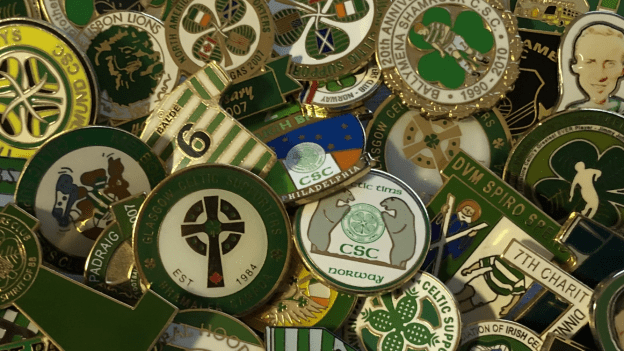
With no Celtic Soul Podcast on International Weeks, we finally got around to updating the Celtic Collectors Badges section on the website shop. Over 100 Badges, some new, some old and some rare ones including CSC badges from around the Globe.
Celtic Conventions, Players, Jerseys, Slogans, Charity badges, Memorable games, Flags, Testimonials, Legends, Fanzine Badges and a few odd ones thrown in.