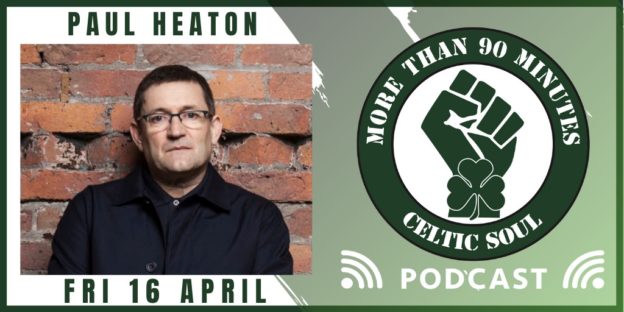
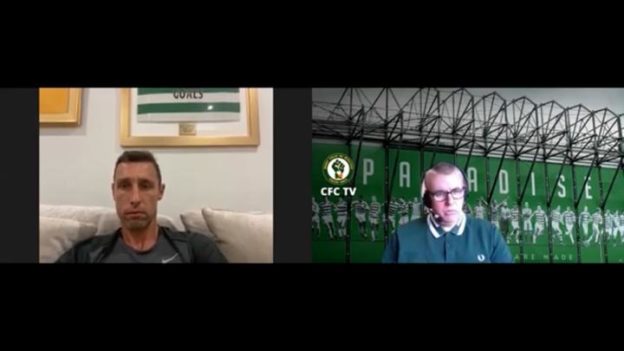
Paul Heaton returns to the Celtic Soul Podcast tomorrow evening for another Happy Hour.
Wonderful response to his chat with Andrew last week.
If anyone fancies sponsoring the Podcasts give us a shout with a PM or email us info@celticfanzine.com
Clink Link to Listen to last weeks conversation
If you would like to support our Independent Celtic Fan Media Platform you can become a Member, Subscribe, Buy or Donate for the Price of a Pint. Your Support helps us continue to produce Daily News & Articles, Weekly Newsletter, Weekly Podcasts, Monthly Fanzine, Video Content & Live Shows
Words almost fail the historian as he tries to assess the contribution made to Celtic by Billy McNeill. A total of 23 medals in major tournaments speaks for itself, as does his total of 790 appearances. His nickname was Cesar, after the actor Cesar Romero. It is a pity that he was not nicknamed after the Roman Julius Caesar to whom he has more similarities.
He was born in Bellshill in 1940. A strain of his family heritage was Lithuanian, hence perhaps his fair hair, and he grew up in tough times in a tough environment. He was intelligent, however, and went to Our Lady’s High Scholl in Motherwell, where it was very soon apparent that he not only was a good football player, but also that he had great leadership qualities. When he graduated to Celtic Park, he met Jock Stein and a long-term bond of mutual affection and admiration was forged.
Billy made his debut in 1958 – troubled times for Celtic – but it was not until Bobby Evans left in 1960 that he really became a regular. He had a good season in 1960/61 but it ended unhappily and taught the young man that football can sometimes be a hard, unforgiving kind of game. In April 1961 his deserved International debut ended in tears when Scotland went down 9-3 to England, and then 11 days later, Billy was in the Celtic side which lost the 1961 Scottish Cup final to Jock Stein’s Dunfermline.
Such reverses taught him the need to battle adversity, but it was to be a long hard road. Billy became captain of Celtic in 1963 – once again a dreadful year for the club. His leadership qualities were much put to the test in the face of management of the club which was not only feckless but even deleterious on occasion. Little wonder that Billy and his attractive wife (who had been a dancer with Andy Stewart on BBC’s “White Heather Club”) considered moving to England as phrases like “for Celtic, the only bright spot was the performance of McNeill” became more regular in newspaper reports.
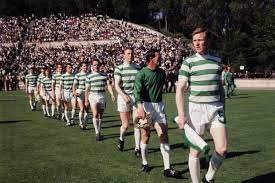
But Stein returned in 1965, and how fitting it was that Billy McNeill was the man whom Destiny chose to head the goal which started it all in April! The relationship between Stein and McNeill was a strong one, it often being said that McNeill was “Stein on the pitch”, and from now on, success flowed virtually non-stop and apparently inexorably.
McNeill was a dominant centre half, especially in the air, but it was his aura of invincibility that was the key thing, and which inspired so many others in the team. It was not that he didn’t make mistakes – one bad one at Celtic Park in March 1969 against AC Milan springs to mind – but they were few, and he could often compensate at the other end with a few goals for the club. Not very many centre halves score in Scottish Cup finals, but Billy did just that in 1965, 1969 and 1972.
The Celtic team at the time was not without one or two difficult characters – Gemmell, Auld, Johnstone could all be complex and feisty – but Billy was usually on hand to calm things down. While all players feared Stein, they respected McNeill, even in the early 1970s when the European glory days had clearly gone, but Celtic still enjoyed domestic success.
When Billy announced his retirement from the playing side of things, it was appropriate that it was at the top at the end of the 1975 Scottish Cup final against Airdrie at Hampden some ten years after the glory years had started at the same ground. He then did TV punditry for a spell (at which he excelled) then became Manager of Clyde, then Aberdeen (with whom he had a very impressive season) before the almost pre-ordained call came from Celtic Park to take up the reins in place of Jock Stein who had never recovered from the transfer of Kenny Dalglish.
McNeill’s two spells as Manager of the club were unfortunate in that he had to deal with a less than helpful Board of Directors, his second spell coming to a sticky end in 1991 when he was made to carry the can for the Board’s selfish unwillingness to compete with Rangers. His first spell from 1978 until 1983 saw him win one honour in each of his five seasons. He made two great buys in the shape of Davie Provan and Murdo MacLeod and unearthed some tremendous talent in the shape of Charlie Nicholas and Paul McStay. When Nicholas was transferred in 1983, McNeill left a month later, ostensibly over the fact the he was not given a contract. Everyone denied that it was anything to do with the transfer of Charlie Nicholas… but we all wondered.
McNeill was no great success in England at Manchester City or Aston Villa. Frankly, he was still obsessed with Celtic, giving himself away repeatedly in radio or TV interviews when he used the word “we” when he talked about Celtic. His return in summer 1987 was inevitable – he would say later that he took about three seconds to make up his mind – and he immediately took a grip of the team, once again made a few shrewd buys and in the Centenary Year of 1988 led the team to a Scottish League and Cup Double in breath taking style.
And yet this was not maintained. McNeill never really recovered from a 5-1 defeat at Ibrox the following August. Even though Celtic would subsequently put Rangers out of the Scottish Cup in each of the next three seasons, Celtic never really challenged Rangers in the League and were even, quite clearly, on many occasions inferior to Aberdeen. They were denuded of resources by a Board of Directors for whom little sympathy is possible, and Billy departed, more or less to private life (apart from TV commentary and punditry), in 1991.
But he remained a very clear and obvious Celtic supporter, being seen in Seville in 2003 for example and on several occasions appearing at Celtic Park as Ambassador and appealing for supporters’ help in contributing to good causes saying things like “I am only asking you to behave the way Celtic supporters normally do” as he very obviously made his own large donation to the particular cause in question.
The statue on the London Road side of the ground is always much visited on match days. It is iconic and worthy. It is such a great tribute to the man whose contribution to Celtic over many years defies quantification. As long as football is played, there will always be talk about Billy McNeill. And the words “of Celtic” will inevitably follow!
Born in 1948, David Potter first saw Celtic at Dens Park, Dundee in March 29. It was a 3-5 defeat, which equipped him admirably for the horrors of the early 1960’s. He had “followed” Celtic for a few years before that and recalls having been called upon to impersonate Jock Stein and receive the family silver teapot which had to do for the Scottish Cup as it was presented on April 24 1954, after he and his father had spent a nerve wracking afternoon listening to the radio! Since then, he has “followed” every Celtic game with bated breath, and has written extensively about the club in magazines and books. His favorite team was that of 1969 (which he rates marginally better than 1967) and his favorite player was Henrik Larsson.
His ambition for Celtic is for them to keep on winning silver in Scotland and to be something in Europe once again. His other interests are cricket and drama. He is 70, a retired teacher of Classical Languages, married with three children and five grandchildren. He now travels on the Joseph Rafferty bus from Kirkcaldy. He also loves Forfar Athletic.
If you would like to support our Independent Celtic Fan Media Platform you can become a Member, Subscribe, Buy or Donate for the Price of a Pint. Your Support helps us continue to produce Daily News & Articles, Weekly Newsletter, Weekly Podcasts, Monthly Fanzine, Video Content & Live Shows
With all the talk of Super Leagues it was Super Leigh Griffiths who came to the rescue last night up in Aberdeen to save Celtic’s blushes and rescue a draw with a last minute goal deep in extra time to after he came of the bench in the second half to replace Eddie who failed to convert his numerous chances and was unlucky to have a goal ruled for off side.
The goal and the appearance could give Leigh a lifeline to play against the Rangers next week and force his way into Steve Clarks Scotland plans for the Euros. Apart from Leighs goal it was a case of same old same old. Missed chances by both teams with Turnbull hitting the woodwork. Shocking defending once again from a set piece cost us dearly.
I hope the new manager has a few defenders up his sleeve when he arrives and a coaching team who can get the basics right because this season has been one defensive error after another. Game after game we have also witnessed poor final balls into the box at the other end so hopefully James Forest will be fit for next Sunday’s return to Ibrox where pride and putting an end to the Rangers unbeaten league run will be at stake.
The management position is still at the back of every fans mind with odds Mourinho now appearing on bookies websites as we wait the outcome of unemployed Eddie Howe or the Celtic board to announce if he will or won’t be the next Celtic manager. Aberdeen got the business done early when changing managers and announcing Scott Brown as part of the coaching staff and it looks to be working out for them not so at our club.
In days gone by if we were coming down the road last night from Aberdeen on packed buses it would have been a case of get the cargo out and a shout of driver get the Rebs on and the conversation would have turned to tickets for Ibrox.
Sadly we are still stuck in Covid limbo and even the WhatsApp groups have fallen silent with the season going from bad to worse and now we wait for the season book conversation to return to the top of the Agenda.
Andrew Milne started More than 90 Minutes in 2001. He has written for numerous publications and online about Celtic. He is a former newspaper columnist with the Daily Ireland and the man behind celticfanzine.com. He is host of the Celtic Soul Podcast & Celtic AM pre-match events at Malone’s in Glasgow on match days and follows Celtic Home & Away. He is a season ticket holder for Celtic FC and the Republic of Ireland. He is also P.R.O. of St. Margaret’s CSC, a member of the Celtic Trust and the Celtic Graves Association.
If you would like to support our Independent Celtic Fan Media Platform you can become a Member, Subscribe, Buy or Donate for the Price of a Pint. Your Support helps us continue to produce Daily News & Articles, Weekly Newsletter, Weekly Podcasts, Monthly Fanzine, Video Content & Live Shows
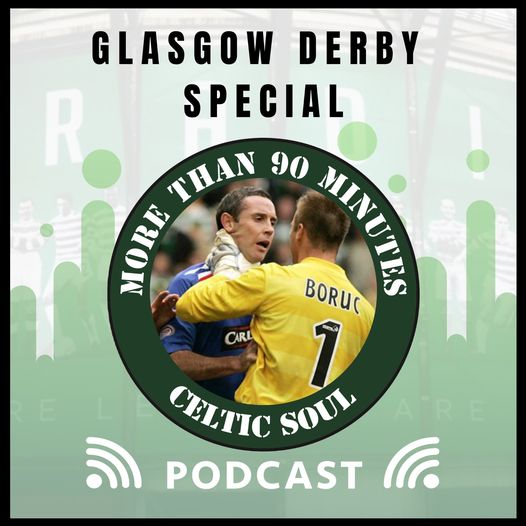
Celtic Soul Podcast Episode 63 with More than 90 Minutes, Editor Andrew Milne chatting to Scott McDonald and Ciaran Kenny on the Celtic AM Glasgow Derby Special. David Potter looks at the history of the local derby and some Celtic Fans share their favourite Glasgow memories.
Scott relives his time playing in the derby, scoring at Ibrox, where he also watched the games as a fan and lifting the League Cup Trophy at Hampden after Darren O’Dea and Aiden McGeady scored in extra time. Scott also pays tribute to Tommy Burns and recounts him losing the head in the Ibrox dressing room after a defeat when he told the players in no uncertain terms what the game means to him and the Celtic fans.
Ciaran Kenny chats about his many bus trips from Dublin to Glasgow to face the Oldco and the Newco including the highs and lows associated with the game.
David Potter recounts the history of the games and when the rivalry started between both clubs and looks back at many battles on the pitch against the blue half of Glasgow,
Celtic Fans young and old from around the globe share some of their favourite moments and memories.
Andrew Milne started More than 90 Minutes in 2001. He has written for numerous publications and online about Celtic. He is a former newspaper columnist with the Daily Ireland and the man behind celticfanzine.com. He is host of the Celtic Soul Podcast & Celtic AM pre-match events at Malone’s in Glasgow on match days and follows Celtic Home & Away. He is a season ticket holder for Celtic FC and the Republic of Ireland. He is also P.R.O. of St. Margaret’s CSC, a member of the Celtic Trust and the Celtic Graves Association.
If you would like to support our Independent Celtic Fan Media Platform you can become a Member, Subscribe, Buy or Donate for the Price of a Pint. Your Support helps us continue to produce Daily News & Articles, Weekly Newsletter, Weekly Podcasts, Monthly Fanzine, Video Content & Live Shows
It was good to see fans, some players and some managers of teams linked with the super league standing united against their greedy owners who will never be happy no matter how much money they generate.
UEFA and FIFA were annoyed over the rich rebel’s breakaway plans but they need to take responsibility for the state of play. UEFA created a Champions League for runners up and also third and fourth placed teams at the expense of the Champions of many countries and FIFA awarding the World Cup to Qatar says it all really about them.
Maybe the Oil Barons, Royal Families and American Banker types that own these clubs were calling the bluff of UEFA to get a bigger financial slice of the cake that the Champions League generates. We all love a European Away Day but as I mentioned we all love a midweek bus to Aberdeen.
If Celtic play in the Champions League or the Highland League the hardcore fans will be there and the football tourists will attach themselves to another team if the Sky Sports coverage is glitzier than a bus to the highlands with your mates and a cargo of cans.
Maybe they were only testing the water on the eve of yesterdays Uefa Champions League announcement. Make no mistake over the last 10 years or more Russian, Gulf, Asian and US money has flooded into European Football…this isn’t over this is only the start …watch this space.
Andrew Milne started More than 90 Minutes in 2001. He has written for numerous publications and online about Celtic. He is a former newspaper columnist with the Daily Ireland and the man behind celticfanzine.com. He is host of the Celtic Soul Podcast & Celtic AM pre-match events at Malone’s in Glasgow on match days and follows Celtic Home & Away. He is a season ticket holder for Celtic FC and the Republic of Ireland. He is also P.R.O. of St. Margaret’s CSC, a member of the Celtic Trust and the Celtic Graves Association.
If you would like to support our Independent Celtic Fan Media Platform you can become a Member, Subscribe, Buy or Donate for the Price of a Pint. Your Support helps us continue to produce Daily News & Articles, Weekly Newsletter, Weekly Podcasts, Monthly Fanzine, Video Content & Live Shows
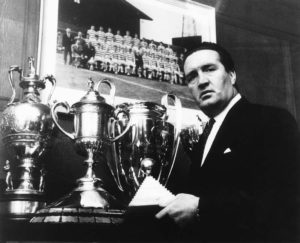
So, in Shakespeare, says the jealous Cassius of Julius Caesar. Had he lived in Scotland between the years 1960 and 1985, there would have been little doubt who the Colossus was.
Jock Stein was a big man in every sense of the word. His bulky frame was ever present, towering over everyone else and the atmosphere changed whenever he was around. More than one newspaper reporter would say that it was obvious whenever Jock Stein had entered the room, even when you had your back to him. Such was the immediate change in deportment and body language from those who were facing him.
Although not without his moments of glory on the playing field, he was not a great player. As a centre-half, he would describe himself in a rare outburst of humour and with deliberate ambiguity as “passable”. He never won a cap for Scotland, and in the one game that he played for the Scottish League, his team was heavily defeated. His best game for Celtic was probably the Coronation Cup final against Hibs in 1953, when he and goalkeeper John Bonnar managed to keep out the great “Famous Five” forward line to bring off an unlikely victory for Celtic.
But it was as a captain and leader that he made his mark, guiding Celtic to a League and Cup double in 1954. When an ankle injury ended his career a couple of years after that, he was appointed coach to the youngsters, as chairman Bob Kelly realised that there was leadership potential there. In that capacity he discovered and brought on great young players like Billy McNeill, Pat Crerand and John Clark, and in other circumstances he might well have moved up to being the manager.
But there were several factors that counted against it. One was that Celtic did not, as a rule, change their manager. Jimmy McGrory was only the third in 70 years of the club. Another factor was that Jock Stein was a Protestant. This would not have mattered anywhere in Scotland or England other than in west central Scotland, and the irony was that being a Protestant, in Stein’s case, did not mean that he attended a Church of Scotland service every Sunday. It meant simply that he had been brought up on the other side of the divide, a factor that weighed heavily with Bob Kelly, but not, as we shall see, with the supporters.
The major factor, however, with Kelly was that Stein would have challenged the chairman’s authority. Kelly was a bully who could always persuade the kindly and gentle Jimmy McGrory to choose the team that he, Kelly, wanted. The chairman, in fact, hid behind McGrory, a man with whom the Celtic fans would find it very difficult to get angry, as his playing career had been such a legend. Stein would not have consented to be the glorified office boy that Jimmy was.
So, for the moment, Stein was allowed to leave Parkhead. This he did in 1960 to go to unfashionable Dunfermline Athletic, at that time struggling to avoid relegation. How Stein made Kelly pay for his decision to let him go! Not only did Dunfermline beat Celtic in Stein’s first game, but a year later in a Cup final that is still painful for Celtic supporters to recall, Dunfermline overcame Celtic in a replay to prolong the trophy famine that had haunted Celtic Park for several years.
In the meantime, Dunfermline had saved themselves from relegation, had established themselves as a force in Scotland and had even made their mark in Europe, beating teams like Everton, for example. Celtic were going from bad to worse with a massive inferiority complex about Rangers, a self-destruct button and an inability to win important games. The massive support occasionally turned violent and nasty, organised boycotts, stopped going to games, and on one spectacular, memorable and painful occasion, 60,000 embittered and stunned supporters turned their backs on Celtic en masse and walked out of the 1963 Scottish Cup final replay against Rangers.
Stein himself, meanwhile, left Dunfermline in 1964, hoping presumably for the call from Celtic, and when that did not come, went to Hibs instead. He was on the point of bringing back the glory days to Easter Road when things got so bad at Celtic Park that changes had to be made. The midwinter of 1964/65 was the nadir of Celtic, and even the thick-skinned Bob Kelly realised that things could not be ignored. Stein was then obvious choice, but there still remained the problem of his religion.
This problem only really existed in the mind of Bob Kelly and a very small bunch of bigots. Celtic supporters, frankly, do not care about anyone’s religion. From the earliest of days men like Sunny Jim Young, Dun Hay, Alec McNair, John Thomson and Willie Lyon had been accepted as footballers. As Willie Maley said: “It’s not a man’s creed or his nationality that counts – it’s the man himself.” Ten years previously the mighty half-back line of Bobby Evans, Jock Stein and Bertie Peacock had all been Protestants, Peacock coming from Northern Ireland and loosely even described as an “Orangeman”.
The support had accepted all of them without a murmur, even when Bertie Peacock was made captain in 1957. Celtic supporters’ concerns about Ireland were political rather than religious. Supporters’ songs did include anthems of Ireland’s struggle for independence over the centuries and there was a desire to see a united Ireland, but religious bigotry never played any great part. Indeed, a sizeable section of the support, particularly from the East of Scotland and including people like my own family who had supported them since the days of Sandy McMahon, were themselves Protestants.
So if Kelly fretted about Stein’s religion, he was doing so needlessly. His hand was, in any case, forced by the dreadful results and his appointment of Jock Stein was, in fact, an abdication. Stein insisted on full powers to pick the team, putting his foot down admirably in the choice of Bobby Murdoch as a right-half rather than a forward (an opinion shared by many of the supporters). Kelly now retired to the business side of the club, doing well enough, however, in the reflected glory brought to Celtic by Stein to earn for himself a knighthood on New Year’s Day 1969.
From 31 January 1965, when Stein’s appointment was announced, Celtic were born again. The Scottish Cup was won in 1965, the other two domestic honours likewise in 1966 and the support returned to fill Celtic Park in a way that had never been seen before. Enthusiasm and young, modern, progressive ideas now took over in a way that was somehow in tune with mid-1960s. This was to be the new world, and the future was going to be Celtic and green-and-white, as pop tunes of the Beatles and others were given Celtic lyrics and the chant of “Jock Stein” was frequently heard. So much for Kelly’s fears of the support being unable to accept a Protestant as a manager.
It was a situation not without its humour. There was on TV a commercial for Heinz Baked Beans which ran along the lines of
“A thousand housewifes every day
Pick up a can of beans and say
Heinz Baked Beans!”
This was changed by Celtic supporters to
“A thousand Catholics every day
Throw their rosary beads away for
Stein! Stein! Stein!”
Stein was not unaware of what the religious situation in Scotland was, and he was shrewd enough to exploit his advantages. Knowing full well that Rangers were reluctant to employ a Roman Catholic for fear of antagonising their support, he would frequently target young Protestant players with a view to persuading them to join Celtic. His thinking was that this would deprive Rangers of a potential recruit – young men like Kenny Dalglish and Danny McGrain joined the club on this basis – whereas young Roman Catholic players would, in any case, wish to join Celtic.
In this respect, his greatest coup came late in his career in 1977. After Rangers had stated publicly that they would now sign Roman Catholics following yet more trouble from their alleged supporters, but had as yet failed to do so, Jock signed Alfie Conn from Tottenham Hotspur – the same Alfie Conn who had played for Rangers a few years previously. The Celtic support accepted Alfie immediately, and Jock then gilded the lily by stating that he was sure that they would. In fact, he had consulted Kenny Dalglish and Danny McGrain about it. There was a subliminal message in all this for those with an eye to see, and that was that the triumvirate of McGrain, Dalglish and Stein, who made this decision, all had one thing in common, and that was that they were Protestants!
Stein, ironically perhaps, was not a practising Protestant, but neither was he a godless man, either. The story is told about the Sunday in Bermuda on a tour in 1966 when the Roman Catholic players went off to Mass, leaving Stein with men like Tommy Gemmell, Ronnie Simpson, Bertie Auld and Ian Young kicking their heels at the hotel. Stein then found out that there was a Church of Scotland on the island, hired a taxi and took his men to it. They sat near the front, sang the hymns lustily, introduced themselves to the overawed minister at the end of the service. They then joined the rest of the congregation in the church hall, drank tea, charmed all the ladies of the choir and held court about football and life back in Scotland.
In 1967 Celtic won the European Cup, a feat totally incomprehensible in the context of their recent history, yet somehow it was as if destiny had beckoned. Anyone who had witnessed or experienced the horrors of the early 1960s would have appreciated any kind of success brought to the club and might, indeed, have settled for the Scottish League Cup once every three years or some such, but this was riches and joy on a scale completely unimagined. Even the oldest of supporters, who could recall graphically the exploits of Jimmy Quinn and Patsy Gallacher, were now convinced that this was the greatest Celtic side of them all.
Other achievements were winning the Scottish League nine years in a row and once after that, eight Scottish Cups and six League Cups, including five in a row from 1965/66 until 1969/70. He also had many near misses in the shape of Cup final defeats, including the tragic year of 1970, when over-confidence after defeating Leeds United in the semi-final led inexorably to Celtic’s downfall in the European Cup final. He also reached the semi-final of that great tournament on another two occasions, losing heartbreakingly on a penalty shoot-out in 1972 and being kicked off the park by a set of hooligans masquerading as Atletico Madrid in 1974. These reverses, however heart breaking at the time, nevertheless represented great success and respectability for Scotland, a point of which the patriotic Stein was very proud.
Stein’s great strength was in his assessment of players. He knew all about Billy McNeill, as he had helped to discover him. He found Bobby Murdoch’s true position; he appreciated the talents of the midfield general Bertie Auld, and he rescued Jimmy Johnstone from a life of under-achievement which might well have led to alcoholism. When he bought a player (something that he did not do very often and never without a considerable amount of thought) it was usually a winner – Joe McBride, Willie Wallace, Tommy Callaghan, Harry Hood, Dixie Deans, Alfie Conn and Pat Stanton, for example, all played glorious parts in the sustained success of Celtic.
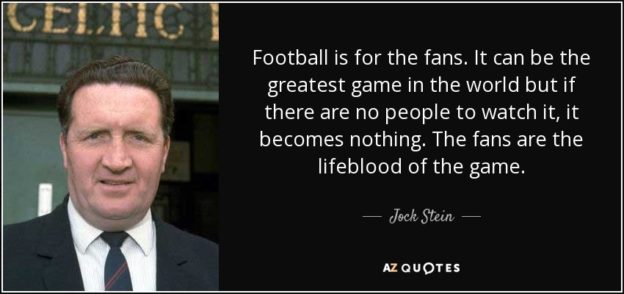
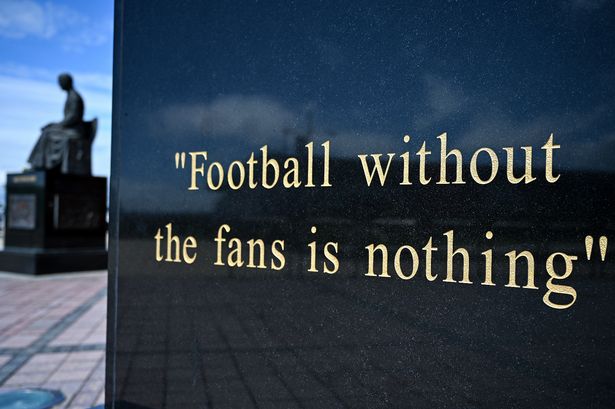
It was his relationship with fans that earned him a great deal of love and respect from the Scottish public. He always said that the fans were the lifeblood of the game,that “football without fans is nothing” and, unlike some others who said that, he actually lived it. He would always attend supporters’ functions and insisted that his players did likewise. He visited sick supporters in hospital in an age before mobile phones and text messaging, on one occasion he personally flagged down buses en route to Dundee to tell the fans on board that the game was off, and once, when a mother wrote to him to tell about her son having rheumatic fever, a football was sent to the boy in hospital, signed by himself and all the team.
Nor did he lack courage in dealing with the hooligan element. On several occasions when bottles were thrown, it was Stein himself who was seen appealing for calm. One or two mindless idiots who invaded the field were physically thrown off by his mighty bulk, and on one occasion at Stirling Albion, with an almost reckless disregard for his own personal safety, he plunged into the middle of the crowd to stop offensive chants.
But his greatest achievement was the virtual destruction of Rangers, and the permanent change that he brought about in their role in Scottish football. Before the arrival of Stein at Celtic Park, Rangers had been the establishment team of Scotland. “We are the people” cried their fans. Boys’ Christmas books were full of laudatory paeans about “Glasgow’s football palace” that was Ibrox. The BBC in Scotland did not disguise their love for the club, and the talk on a Monday in Glasgow’s tearooms included discussion on how the Gers had done.
A blind eye was turned to their discriminatory policy. If any person of liberal leanings were to ask why a Roman Catholic never played for Rangers, shoulders were shrugged and things like “It’s always been like that” or “The Royal Family does the same” were said. Newspapers never even mentioned the subject. Notoriously, the Sunday Post, the family newspaper which reached 84 per-cent of Scotland’s population avoided the issue, and the Church of Scotland, by saying nothing, also gave tacit support. The Labour Party achieved an astonishing balancing act of incor
porating the Catholic working class (sometimes even changing their colours from red to green in certain constituencies at election time) while not offending the Protestant supporters. They, too, said nothing.
On the streets, it was acceptable for Rangers supporters to ridicule the Pope and the Irish race in public, while using the word Fenian (at least 60 years after it had ceased to mean anything) to describe anyone who supported Celtic. The Union Jack and the Royal Family were the exclusive property of Rangers, it seemed, something bitterly resented by those who had fought in one or other of the two wars of the 20th century, and even God himself seemed to support the establishment club.
That was the position in 1965. A decade later, Rangers had been publicly exposed as a poor team with an isolated and marginalised support, increasingly prone to the outbursts of hooliganism which had disgraced Celtic’s good name in the era now described as B S (Before Stein). Some of Rangers’ public supporters, like the comedian Andy Cameron, for example, was asking publicly whether Rangers should not sign a Catholic. Stories went around that Rangers had one day played a Roman Catholic – but he had beaten them 2-1!
Jock Stein had, in fact, driven a horse and cart through Rangers, and he had done it by playing football which was both successful and popular. The 1967 victory in the European Cup had perhaps not gone down well with everyone in Scotland, but it could not be denied that many supporters of other teams (even a few of the more decent Rangers supporters and certainly many supporters of English teams) were delighted to join in the triumph of Celtic. It was in a very real sense a victory for Scotland, as every single man in the squad was Scottish, while Irishman Sean Fallon, the assistant manager, was the solitary exception among the staff. This had come at a time when Scotland needed a triumph, just a year after England had won the World Cup.
Newspapers now talked about little other than Celtic. To a large extent, Stein engineered this, realising that there is no such thing as bad publicity. He would always be prepared to give newspapers a story for a dull November Tuesday, and he had the unfailing ability to knock Rangers off the back pages. The Ibrox men would perhaps have had a good win on the Saturday and therefore expect maximum publicity on the Monday – but the back page would have a story about how, for example, Celtic were thinking of arranging a friendly with a crack Brazilian outfit. This story might or not have substance, but it mattered not. All that really mattered was that the word “Celtic” was there on the back page of the Scottish Daily Express in larger letters than that of “Rangers”.
Stein himself was a frequent and welcome participant in TV programmes, and it was often said that he was the only Scotsman who could be instantly recognised in England when he was seen on the screen. This was most obvious after the defeat of Leeds United in the European Cup semi-final of 1970. There is a myth about this game that everyone in England resented the Scottish upstarts beating their darlings. Not so! Leeds, with their somewhat robust approach to the game, were by no means popular with fans of other clubs, and the victory by a Scottish club was much welcomed. Stein became as well known and loved a Scotsman as Robbie Burns, as he did seem to represent Scotland.
He differed from the Ayrshire bard of two centuries previously in his attitude to alcohol. He had possibly seen rather too much alcohol abuse in his early life in the mining communities, and he was a committed and even obsessive teetotaller. He did try to make his players the same, but in some cases failed miserably. It was not for the want of trying. European trips and foreign tours would see Jock prowling hotel corridors and foyers, getting chambermaids and bellboys to spy on the prime suspects and even listening outside bedroom doors for the tell-tale sound of bottles being clinked.
He was, as we said, not entirely successful, but his efforts did make sure that his players were usually as fit as they could possibly be. In this he was backed by trainer Neil Mochan (himself by no means a teetotaller) and he would frequently say that there was no excuse for a professional footballer not being 100 per-cent fit. Bobby Murdoch, arguably his best player for Celtic, presented a special problem in that he was prone to putting on weight. On two occasions when this seemed to be a problem, Murdoch was whipped off to a health farm in England to lose a few pounds. Stein had identified him as a key man and well worth going the extra mile for. There was a sequel years later when Stein and his wife met Mr and Mrs Bobby Murdoch on holiday. Bobby was by this time playing for Middlesbrough and was enjoying a pint of beer in the Mediterranean sunshine. This did not prevent Stein berating him about what it could do to him. “You’re far too good a player for that” thundered Jock, forgetting that Bobby was now playing for another club.
But if he went the extra mile for Bobby, he had to go several more for Jimmy Johnstone. The relationship between Stein and Johnstone was complex. Both were, in their own way, in awe of the other, in total admiration for what the other could do. But Jimmy enjoyed life as well. “He was not daft, was Jimmy – he just did daft things” was the way that it was put by one of his team-mates, but he did have the ability to get on the wrong side of his strict taskmaster. Yet although Stein twice gave him a club suspension and dropped him countless times for indiscipline, he was always very careful not to antagonise Jimmy completely. Johnstone would now and again throw a tantrum and ask for a transfer. Jock would not play ball with that idea as he knew how valuable Jimmy was to the club. He also, from a wider footballing perspective, knew that Jimmy was far too engrossed in Celtic to do a job for anyone else. Nevertheless, Stein would often say that his greatest achievement was not so much winning the European Cup or nine League championships in a row as keeping Jimmy Johnstone in the game.
But it would be wrong to say that he kept everybody happy. Tommy Gemmell, John Hughes, Charlie Gallagher, John Fallon – good players all – he fell out with, and very often the falling out led to a permanent rupture in relationships. Tommy Gemmell, for example, got himself sent off while playing for Scotland in a World Cup game against West Germany in 1969. Stein, although having no direct dealings with Scotland at the time, felt that he had let his club down as well as his country and dropped him for the League Cup final the following Saturday. Relationships were never quite the same again after that, and John Hughes was never forgiven for missing a chance in the 1970 European Cup final. Charlie Gallagher’s Celtic career had come to an end, and he was lining up for Dumbarton when he was appalled to hear his direct opponent, Davie Hay, being encouraged to “break his legs”.
Stein also had a problem with goalkeepers. He never understood that breed, and the only one of his many custodians that he could be said to have established a modus vivendi with (and even that one had a sticky start) was Ronnie Simpson, whose sheer length of experience in the game demanded respect. Apart from that, goalkeepers came and went, errors were not forgiven, and there never was (apart from the aged Simpson) any great Celtic goalkeeper in the Stein era. John Fallon, Evan Williams, Ally Hunter, Denis Connaghan, Peter Latchford and Roy Baines all tried, but Jock was never entirely happy with any of them.
Stein’s life changed radically for the worst in summer 1975. Early in the morning one day in early July on the A74 he was involved in a head-on collision while returning from holiday along with some friends. He was seriously injured, and out of action for about a year. During his absence, Celtic suffered, but then we had one brilliant season of Stein before a major misjudgement led to his downfall at Celtic Park.
Season 1975/76 was spent in hospital. It was hardly a surprise that this was the first trophyless campaign for Celtic since 1963/64, the one before his arrival. But in 1976 Stein returned, and in the same way as he re-created Celtic in 1970 after the loss of the European Cup final, he did the same with the dispirited Celtic of 1976. In particular, his judgement in the transfer market was spot-on. The signing of Alfie Conn, as well as being a major embarrassment to Rangers and a further consolidation (if any were required) of the moral high ground, was also a brilliant piece of footballing judgement. Joe Craig had been bought from Partick Thistle as a centre-forward, and all Scotland was amazed by the signing of Pat Stanton from Hibs. Stanton had been indelibly linked with Hibs for over a decade and was clearly coming to the end of his career. But Stein had always admired him and bought him to win the only Scottish League medal and Scottish Cup medal of his career.
These additions, plus the development of young talent like Tommy Burns and Roy Aitken, contributed towards what, in the circumstances, was a fine season for Celtic. The summer of 1977 was passed in contentment. There was the feeling that Jock was now back in charge after his unfortunate accident, and that further glory beckoned for as long as we cared to contemplate. After all, Jock was not yet 55, and seemed to have loads of mileage left in him.
But his nemesis came in the shape of Kenny Dalglish. The relationship between Kenny and Jock was complex. It was Jock who had discovered him and made him the idol of the Celtic support, and now he had a virtually automatic place in the Scotland side. But Kenny was not happy at Parkhead. It cannot have been money, as he was surely earning enough with Celtic; it cannot have been the fact that he came from a Rangers-supporting background, as he was hardly the only one who had that problem, if problem it was. It may have been an inability to put up with the growling dictatorship of Stein, and in particular it may have been a lack of confidence in Jock’s ability to win another European Cup.
Celtic were involved in a gratuitous and really rather pointless tournament in Australia in summer 1977. Dalglish, recently back from a Scottish tour of South America, was not keen on going, and ended up not going, leaving a rather large question mark on his Celtic future. This was now the acid test of Stein. He had done well in years gone by to retain men like Jimmy Johnstone when they turned awkward. How would he react to this latest threat?
This time the magic did not work, and Kenny, to the distress of Celtic fans everywhere, was on his way to Liverpool for a huge transfer fee of £440,000, a British record. It was possibly true that nothing Stein could have done would have kept Dalglish, and there may be something in the school of thought that says the directors were, not for the first time, more interested in the money than they were in the building of a great team.
Other problems hit the team as well, in the shape of early-season and serious injuries to Pat Stanton and Alfie Conn, and then Danny McGrain went down with a mysterious foot injury. But it was the loss of his young protege that hurt Stein. He lapsed into a depression which contrasted so starkly with his exuberant joie de vivre of a decade earlier. The team’s form suffered, the season was over almost before it began and Celtic went out of Europe to a mediocre Austrian team, after which Stein, that notorious prowler of hotel corridors on previous trips, retired to bed, thus abdicating his responsibility and abandoning himself to self-pity.
The transfer of Dalglish, however distressing it was to all concerned, need not have been the cataclysm that it was allowed to become. There was now money in the bank, and there would have been no lack of talented young men currently playing for other clubs in Scotland and England who would have jumped at the chance of coming to Celtic. But big transfers never came, and Stein, giving the impression that he was only doing this to get the fans off his back, bought several low-key players, or men who were clearly well past their best. In fact, they disgraced the Celtic jersey which Stein had always claimed “did not shrink for inferior players”. One player was bought from England, was made captain immediately and then scored an own goal on his debut!
This was desperately awful stuff, and although a brave and unlucky effort was made in the Scottish League Cup, the team, virtually leaderless and dispirited, went nowhere. Celtic finished 1977/78 in disarray, and it was almost a relief when Billy McNeill, who had had a great season as manager of Aberdeen, was made manager at Celtic Park in May. Stein was not sacked, but was humiliated even more by being offered the job of organising the Celtic pools! This was not likely to last, and Stein accepted the manager’s job at Leeds United for a brief spell before becoming manager of Scotland.
This was 1978, the year that still causes Scottish hearts to recoil in horror at the thought of Argentina. Stein was not involved in this fiasco, but was employed by the BBC to sit in the studio and analyse. It was curious to see him in this role, now no longer the man who mattered at Celtic. But there was the elder statesman look about him as he sympathised with Ally MacLeod, saying things like: “Once they cross that touchline, there is nothing you (the manager) can do”. Clearly he shared the national agony as penalties were missed, games were lost to no-hopers, drugs were taken and players disgraced themselves and their country. His pain was our pain, but his pain was also greater, as he had now lost his own empire as well.
He would serve as manager of Scotland from autumn 1978 to autumn 1985, when he collapsed and died tragically at Ninian Park, Cardiff, seconds after his team earned a play-off for a place in the World Cup finals. His international record was respectable, but no more than that. He deserves credit for winning back some credibility for Scotland after Argentina, but he was unable to lift his country on to the top rung of the world game.
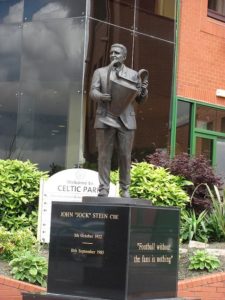
It was with Celtic that he was the cult hero. A stand, the one which replaced the traditional Celtic End, where supporters used to stand at Old Firm games, is named after him. There is inside Celtic Park a bust of him inside the foyer. This is inadequate. There is also a statue outside the stadium, beside that of Brother Walfrid, of him with the European Cup. A statue of Willie Maley, Celtic’s other great manager, should also be there, and possibly one of Fergus McCann, who re-created the ground in the 1990s. But no-none has ever done more for the club than Jock Stein.
It is often worth while considering what might have happened if Stein had not gone to Celtic in 1965. There would have been no European Cup, and the game in Scotland would have been stagnating towards part-time football at home and oblivion abroad, as Rangers won everything in Scotland but nothing in Europe. Celtic’s vast support, frustrated and angry, would have given up watching the game, choosing instead to cause trouble in Scotland’s towns of a Saturday afternoon and perhaps turning to paramilitary organisations to express, in a thoroughly deleterious and subversive way, their Scottish-Irish identity.
Such Scottish players as did emerge would have been immediately signed on by English clubs, and Scotland, in short, would have become similar to what Ireland is today – with loads of interest in football but loyalties given to English teams like Manchester United, Liverpool and Arsenal rather than the indigenous ones. It was just as well, was it not, that Bob Kelly admitted he was wrong in 1965?
Born in 1948, David Potter first saw Celtic at Dens Park, Dundee in March 29. It was a 3-5 defeat, which equipped him admirably for the horrors of the early 1960’s. He had “followed” Celtic for a few years before that and recalls having been called upon to impersonate Jock Stein and receive the family silver teapot which had to do for the Scottish Cup as it was presented on April 24 1954, after he and his father had spent a nerve wracking afternoon listening to the radio! Since then, he has “followed” every Celtic game with bated breath, and has written extensively about the club in magazines and books. His favorite team was that of 1969 (which he rates marginally better than 1967) and his favorite player was Henrik Larsson.
His ambition for Celtic is for them to keep on winning silver in Scotland and to be something in Europe once again. His other interests are cricket and drama. He is 70, a retired teacher of Classical Languages, married with three children and five grandchildren. He now travels on the Joseph Rafferty bus from Kirkcaldy. He also loves Forfar Athletic.
If you would like to support our Independent Celtic Fan Media Platform you can become a Member, Subscribe, Buy or Donate for the Price of a Pint. Your Support helps us continue to produce Daily News & Articles, Weekly Newsletter, Weekly Podcasts, Monthly Fanzine, Video Content & Live Shows
A midweek bus trip to Aberdeen with your mates would be the perfect medicine to get over Sunday’s result in the Glasgow Derby but with no fans at football or in the pub to talk about the game and the fallout from this season it’s hard to get yourself up for the game. Like so many I spent Sunday evening at home wondering how we have fallen so far so quick.
All the talk in the last day or so has turned to the European Super League proposal so it was interesting to hear John Kennedys take on it at the press conference today and he also reflected back on Sunday’s defeat and looked ahead to Aberdeen.
It may be a dead rubber game with no silverware to compete for but these players should have pride when pulling on the jersey and it was positive to hear Greg Taylor echo that today when he spoke to the press.
With Dominic McKay arriving yesterday after sitting with the other board members at Ibrox on Sunday, I hope he comes out and gives us some details on the direction the club are taking no matter what color his suit or tie is while we wait for the appointment of a first team manager.
The sooner the better the manager is announced with no white smoke on Eddie Howe we will now have to listen to endless talk of Keane and even Mourinho now he has got the sack from Spurs.
Andrew Milne started More than 90 Minutes in 2001. He has written for numerous publications and online about Celtic. He is a former newspaper columnist with the Daily Ireland and the man behind celticfanzine.com. He is host of the Celtic Soul Podcast & Celtic AM pre-match events at Malone’s in Glasgow on match days and follows Celtic Home & Away. He is a season ticket holder for Celtic FC and the Republic of Ireland. He is also P.R.O. of St. Margaret’s CSC, a member of the Celtic Trust and the Celtic Graves Association.
If you would like to support our Independent Celtic Fan Media Platform you can become a Member, Subscribe, Buy or Donate for the Price of a Pint. Your Support helps us continue to produce Daily News & Articles, Weekly Newsletter, Weekly Podcasts, Monthly Fanzine, Video Content & Live Shows
Football used to be the game of the working class, after a week down the mines or in the factories, Saturday at 3pm was the highlight of the week when grandad’s, son’s and grandsons made their way to the old stadiums with their scarfs and rosettes to watch their team play the beautiful game.
Dublin, Glasgow, Manchester, London, this was the game of the people, the beautiful game, In ’56 the European Cup was formed and became the greatest tournament in world football, only the league winners qualified, Madrid, Benfica, the two Milan’s, Celtic in ’67, Man U a year later, Liverpool in the 1970’s, Juve, Barca, it was wonderful football and the teams equal but then in the 1990’s along came Murdoch and Sky and the EPL and it became a game of the elite.
Russian, American and Arab hedge fund merchants arrived and the greed for wealth became paramount and the fans became clients or customers, clubs who were nobody suddenly became superpowers, Man City, Chelski, PSG, football was distorted as the old EC became the Champions League, then you didn’t need to win your league but could be as low as 4th, it was a farce but all driven by greed.
The past year has seen the virus and empty stadiums and the Oligarchs and billionaires have realised do we really need fans in the stadium at all? So we have arrived at plans for a new European Super League, you don’t qualify but get invited, no relegation or promotion, shown live midweek to a world wide audience on iPads, iPhones, Now TV and Sky, and the crucial point, it’s worth billions to the clubs involved and f**k the rest of football.
It’s an absolute sham! At the same time UEFA announced new plans for a revamped CL, admittedly it’s also driven by the big clubs and finance but at least it’s a fairer system where you qualify on ability, a meritocracy, it will be interesting to see how that pans out.
Hopefully FIFA throw these clubs out of football, see how happy they will be then when they can’t play in their own leagues and their players can’t play for their international teams, that will put the cat among the pigeons.
Football has become difficult in recent times with all the money involved, it’s not the game I fell in love with 60 years ago, this could be the final straw unless UEFA give these greed merchants the boot.
Paddy McMenamin was born in Belfast with Donegal and Tyrone parents. He spent the 70’s in Long Kesh. He has been going to Paradise since the Benfica game in Nov. 1969. He lived in Donegal for 30 years but now lives in Galway. He returned to University at 50 and became a secondary school teacher of history and English.
If you would like to support our Independent Celtic Fan Media Platform you can become a Member, Subscribe, Buy or Donate for the Price of a Pint. Your Support helps us continue to produce Daily News & Articles, Weekly Newsletter, Weekly Podcasts, Monthly Fanzine, Video Content & Live Shows
Celtic AM Glasgow Derby with Andrew Milne joined by Ibrox goal hero Scott McDonald, David Potter, Ciaran Kenny, The Blarney Pilgrims and a few friends to talk Celtic.
If you would like to support our Independent Celtic Fan Media Platform you can become a Member, Subscribe, Buy or Donate for the Price of a Pint. Your Support helps us continue to produce Daily News & Articles, Weekly Newsletter, Weekly Podcasts, Monthly Fanzine, Video Content & Live Shows
Celtic go into the game in probably the best form we have seen the whole season, still undefeated under interim boss John Kennedy. We had a great win last week against a Livingston side we have struggled with this season. Looking back at the last Glasgow Derby we were unlucky not to take the full three points instead settling for a draw.
Its a chance for the Celtic players to remind the whole of Scotland how good they can be. It would be a welcome boost to the supporters to knock out the Ibrox side on their own patch.
New CEO Dominic McKay starts at Celtic Park next week and a win would be a good start to his tenure, his first week could be even better if a new manager/head coach was appointed next week too.
Speaking on the clubs website on Friday, Kennedy said, “I’m not going to put too much pressure on myself or the team – it’s about performances, it’s about being clear. Sometimes the emotion of these games overrides the clarity of your judgement.
“We have to be clear in terms of what the game means and what we have to do to perform in that game and hopefully that brings a positive result.
“A massive part of Sunday will be about the result. Even if the performance isn’t perfect, we want to show the mentality and willingness to go and work and run, and even if we need to grind it out, we’ll try and grind it out.
“We know we’ve underperformed this season, Rangers have been very good, but we want to make sure that over the time the gap maybe isn’t as big as people think.”
Mick Kane hails from Glasgow. He has been hooked on Celtic since he went to his first game when he was 7. Celtic beat Hamilton 8-3 at Celtic Park on the 3rd of January 1987. His favourite player at the time, Brian McClair scored four goals.
He started going regular as a 16 year old when Celtic played at Hampden for the season, being a Southsider it meant a short train journey to get to Hampden. From then he has had a season ticket travelled around Europe for games as Celtic became the dominant force in Scottish football again. A nice change from growing up during Rangers run to 9 in a row.
If you would like to support our Independent Celtic Fan Media Platform you can become a Member, Subscribe, Buy or Donate for the Price of a Pint. Your Support helps us continue to produce Daily News & Articles, Weekly Newsletter, Weekly Podcasts, Monthly Fanzine, Video Content & Live Shows