The transfer window slammed shut last night but this morning, Sky Sports News continue to drain the last few hours of repeating themselves over and over again about who went where. The biggest talking points concerning Celtic is the lack of activity with so many players under performing and wanting away from the club. I expected more to leave and I had hoped to see a winger, a central defender and a goalkeeper come in alongside right back Jon Joe Kenny who arrived from Everton on loan.
Following on from the departure of Jeremie Frimpong, the new right back should go straight into the team for tonight’s visit to Kilmarnock and that terrible plastic pitch which will allow Kristoffer Ajer to slot back into central defence at the expense of the the under performing Shane Duffy or Nir Bitton.
The expected signing of Ben Davies from Preston on a pre-contract went tits up when he signed for Liverpool for £2 million yesterday. The most frustrating thing is we had a full month to tie him up and sell him the club and agree terms before Liverpool entered the race. A full month!
The goalkeeping situation is still a serious concern with only two clean sheets out of six in an abysmal January. Scott Bain is the No. 1 at the moment but it might have been so different if the club had agreed terms with Southampton and Frazer Forster to bring the big stopper back in the Summer or at the very least hold onto the experienced Craig Gordon for such an important season.
When news filtered through that Davies was on his way to Anfield, panic set in at Celtic Park and we were linked with Spurs defender, Japhet Tanganga but that news soon fizzled out.
Instead of a goalkeeper coming in, a young one went out Liam Hughes is a player I know little about but Liverpool have seen something in him and signed him to develop in their under 23 squad.
The only other news of Celtic interest from the transfer window is Olivier Ntcham finally getting his move away from Celtic on loan to Marseille until the end of the season at least. He had been expected to exit in the Summer.
Celtic fan Boyle_67 on twitter summed up how many Celtic fans are feeling right now with this tweet.
“Olivier Ntcham wants to go to Marseille their fans were setting fire to their training ground yesterday and that’s still a more attractive prospect than staying at Celtic.”
For me Ntcham’s winning goal in Rome last season against Lazio will live long into the memory as will his goal against the Rangers a few seasons ago. The French man was another player who split the opinion of the fans, no doubt about his talent but sadly he spent a lot of his time warming the bench. Good luck to him, I can still taste that bottle of red wine I celebrated with late into the night in Rome. When we could travel, watch the Celtic, squash into sweaty pubs like sardines and hug complete strangers!
Andrew Milne started More than 90 Minutes in 2001. He has written for numerous publications and online about Celtic. He is a former newspaper columnist with the Daily Ireland and the man behind celticfanzine.com. He is host of the Celtic Soul Podcast & Celtic AM pre-match events at Malone’s in Glasgow on match days and follows Celtic Home & Away. He is a season ticket holder for Celtic FC and the Republic of Ireland. He is also P.R.O. of St. Margaret’s CSC, a member of the Celtic Trust and the Celtic Graves Association.
If you would like to support our Independent Celtic Fan Media Platform you can become a Member, Subscribe, Buy or Donate for the Price of a Pint. Your Support helps us continue to produce Daily News & Articles, Weekly Newsletter, Weekly Podcasts, Monthly Fanzine, Video Content & Live Shows.
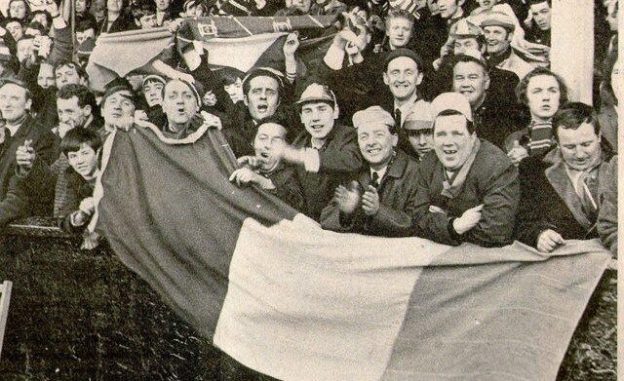
It is remarkable to think that we have had 60 years of “Sure It’s A Grand Old Team to Play For”. It was released in October 1961 and sung by Glen Daly, and very soon it became a recognised Celtic anthem. It has not been imitated all that much by supporters of other teams, although occasionally on TV, you hear it being played on the PA at Everton games (although not really sung by their fans).
But it has now been a traditional part of the Parkhead Matchday experience for a long, long time, even though one would have to admit that some of the lyrics are crass. Is it, for example, true that “we don’t care if they win, lose or draw”? I think not. One’s weekend and midweek in the football season, are, and should be, defined by how well Celtic have done! You cannot really call yourself a Celtic supporter otherwise. And what does “Darn the hare we care” mean. Is it “hair” or “hare”, in any case?
But it is a cheery song, with a beginning like “76 trombones led the big parade” , a hit in about 1959 or 1960. So who wrote it? I have heard various pretenders for the throne, notably a reserve player called Eddie Dowdalls (a relation of the trainer Alec) who claimed to have written it on a bus on the way to a reserve game at Cowdenbeath. But there are other claimants as well. It certainly seemed to have come together in that awful summer of 1961 (just after the Dunfermline Cup final) and Glen Daly released it in the autumn with, on the other side, “An Irishman’s Dream” about Ireland moving to the USA with Shannon becoming like the Hudson, every girl being an Irish colleen and other lovely romantic stuff. It was an old pub favourite, just like “If We Only Had Old Ireland Over Here” which was the Australian version of it. Everyone had a father, uncle or grandfather who could be relied upon to reproduce it, (with a greater or smaller degree of musical harmony) every New Year.
Its success was immediate. By early November 1961 it was being sung hesitatingly by a few guys struggling for the words, but by December, it was beginning to resound around Parkhead particularly in a game where the team beat Partick Thistle 5-1. A couple of weeks later, when Hibs came to town and Celtic won a thriller 4-3, everyone was word perfect, more or less, although from an early stage “We don’t care what the Rangers say” had displaced our apparent indifference to the result. A couple of days before Christmas, the good people of Kirkcaldy saw the train doors opening and green and white hordes jum
It was all possibly coincidence, but the team enjoyed a good spell at this point. Indeed December 1961 made one believe that there was indeed “going to be a show”. Well yes, there was, some 5 and a half years later in Lisbon, but in late December 1961 Celtic suffered a bad blow or two with the weather. The game at Motherwell was frosted off as indeed was the New Year Day game at Celtic Park which might have been a pivotal one, and all this played havoc with the nerves of our talented but young and fragile side, which had been on the crest of a wave up to now. Dismal draws now became the order of the day and although spring 1962 was not without its fine moments, the team disappointed at the end and even the song could not lift them up.
Born in 1948, David Potter first saw Celtic at Dens Park, Dundee in March 29. It was a 3-5 defeat, which equipped him admirably for the horrors of the early 1960’s. He had “followed” Celtic for a few years before that and recalls having been called upon to impersonate Jock Stein and receive the family silver teapot which had to do for the Scottish Cup as it was presented on April 24 1954, after he and his father had spent a nerve wracking afternoon listening to the radio! Since then, he has “followed” every Celtic game with bated breath, and has written extensively about the club in magazines and books. His favorite team was that of 1969 (which he rates marginally better than 1967) and his favorite player was Henrik Larsson.
If you would like to support our Independent Celtic Fan Media Platform you can become a Member, Subscribe, Buy or Donate for the Price of a Pint. Your Support helps us continue to produce Daily News & Articles, Weekly Newsletter, Weekly Podcasts, Monthly Fanzine, Video Content & Live Shows.
February has arrived and signals the start of Spring but a dark winter cloud still hangs over Celtic Park with fans angry that the boards January review has not been published. Celtic SLO John Paul Taylor has requested it from the board but it has fallen on deaf years.
It would seem that no matter what happens at the club the board refuse to take on the opinion of the Celtic Support who have forked out their hard-earned cash to support the club for a virtual experience this season which has seen us surrender the title to the Rangers without putting up a fight.
The Celtic support are very angry and frustrating with the refusal of the board to engage in real communication and tell us about the direction the club are going in now that the title challenge is all but finished while the media talk about Celtic being in a battle of second place with months of football yet to play.
During January we watched Celtic stumble from one disaster to another, only managing to win one out of six against relegation candidates, Hamilton. I can’t remember a month where we have been so poor. The blame game continues the fans are blaming mismanagement at board level and their refusal to sack the manager, the players are blaming each other and Neil Lennon is blaming the player
Eyebrows were raised when news broke that Neil Lennon was planning for next season when not even his biggest fans believe he should be allowed to continue as the manager. Football is results business and the results alone in January would have seen many previous managers of our club walk the plank.
I find it hard to believe that a club like Celtic have no plan B. Surly Dermot Desmond and the board are working behind the scenes to recruit a new manager who can stop the rot. I will take no pleasure in seeing a great servant of Celtic like Lennon, be removed from his position back at the start of December I backed him like so many fans to turn the season around but now watching the slow death of this season has become more painful to watch with every 90 minutes that passed on the pitch in January.
Andrew Milne started More than 90 Minutes in 2001. He has written for numerous publications and online about Celtic. He is a former newspaper columnist with the Daily Ireland and the man behind celticfanzine.com. He is host of the Celtic Soul Podcast & Celtic AM pre-match events at Malone’s in Glasgow on match days and follows Celtic Home & Away. He is a season ticket holder for Celtic FC and the Republic of Ireland. He is also P.R.O. of St. Margaret’s CSC, a member of the Celtic Trust and the Celtic Graves Association.
If you would like to support our Independent Celtic Fan Media Platform you can become a Member, Subscribe, Buy or Donate for the Price of a Pint. Your Support helps us continue to produce Daily News & Articles, Weekly Newsletter, Weekly Podcasts, Monthly Fanzine, Video Content & Live Shows.
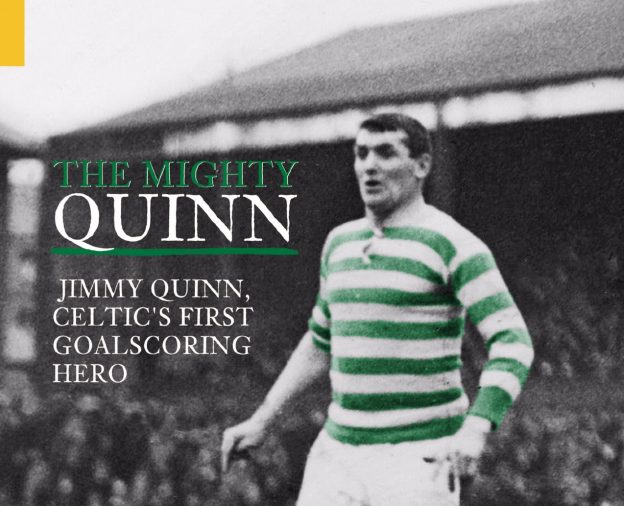
Over one hundred years have now passed since the floruit of the great Jimmy Quinn. He still remains a potent legend in the impressive pantheon of that great Celtic club. Indeed, it is significant in the Willie Maley song that the first verse referring to the early days of the club states that “Gallacher and Quinn have left their mark”. The Gallacher was, of course, Patsy Gallacher, and the Quinn was the miner boy from Croy.
Jimmy came out of the pits to play for Celtic and, after his career was over, that was where he returned. He was a simple working miner, like so many Celtic heroes, whose life differed from so many others only in that he was a great football player. No pretentiousness, no snobbery, not even a noticeably wealthier lifestyle. He was simply Jimmy Quinn of Croy.
Croy was an Irish village, deliberately created by the William Baird Company to house the Irish immigrants and to keep them apart from the Protestants of Kilsyth. There was a tradition every 12 July that the barricades were manned at a spot called Finger Post corner on the outskirts of the village to keep out those intent on attacking adherents of the Catholic faith. To this day, it will be hard to find anyone in the village who does not love the Glasgow Celtic.
Quinn joined Celtic in early January 1901. Symbolically at the start of a new century, the great Willie Maley was embarking on a new beginning for Celtic. He had been manager since 1897, and although the Scottish League had been won in 1897/98 and the Cup in 1899, he was worried about the massive strides taken by this other Glasgow team, the Rangers, who seemed as if they would mount a long-term challenge to the likes of Celtic, Hearts and Queen’s Park. The men from Ibrox had won the League in 1898/99 and 1899/1900, looked like doing the same in 1901, and it was really up to Celtic to stop them.
But for that, Maley needed youngsters. His spies scoured the country, and consistent reports reached his ears about this youngster called James Quinn of Smithston Albion. Maley met him, was impressed by his earnestness, enthusiasm and build, took a chance and signed him on as a left winger in the first instance.
Jimmy was unlucky in 1901 and 1902 to be on the losing side in Scottish Cup finals, but he did have one great day at the Glasgow Exhibition Trophy final of 1902 when his hat-trick beat Rangers.
Some say the Rangers are guid at fitba’
That Smith and Gibson and Speedie are braw,
But Jimmy Quinn, he diddled than a’
At the Glasgow Exhibition, oh!
Yet consistent success was hard to come by for the youngster. Maley could not really make up his mind what Quinn’s best position was, nor could Quinn himself, for although he was always willing to play anywhere he was told, the brawny youngster never seemed able to settle on to a consistent seam of form.
Season 1903/04 was a pivotal one for Jimmy. It was the first in which Celtic wore the green-and-white horizontal stripes (in time they would be called the Hoops) as distinct from the vertical ones, and it was also the first season of the new Hampden Park, opened on 31 October 1903. The grand venue’s first Scottish Cup final would be staged on 16 April 1904, and appropriately the teams taking part would be Celtic and Rangers.
Quinn’s appearance in the centre-forward position for that final was fortuitous. Alec Bennett had been the centre-forward, but had also been the centre of speculation over a possible transfer to Rangers, a club for whom the player, a non-Catholic, had a certain sympathy. Maley decided to drop Bennett from the final, play Bobby Muir on the right wing, and move Jimmy Quinn, who had hitherto been all over the forward line, to the centre-forward position.
The Scottish Cup final was Quinn’s big chance. He seized it, determined to make a name for himself as a spearhead. He had been more than a little dispirited by his failure to hold down any position and had been thinking of going back to the mines in Croy, but this was a Scottish Cup final. He had twice experienced the bitterness of defeat in that gala encounter, and at one point in the first half may well have felt that a similar thing was about to happen.
Celtic were two goals down, and it was beginning to look as if Maley’s idea for the forward line was not going to work. Maybe it would have been better for Bennett to have played after all; maybe Quinn, who had thus far been overcome by nerves any time the ball came near him, was not really a centre-forward at all. But there was a great deal of the game to go yet, for half-time had not even been reached. Quinn got the ball on the halfway line and kicked it forward. It held up in the wind and Jimmy charged forward, using his mighty bison-like shoulders to barge two Rangers defenders out of the way before drilling home a great goal. Minutes after that, fine work from Bobby Muir on the right enabled him to fire a ball into the goalmouth where Quinn hammered home a second.
Thus at half-time things did not look all that bad. Two goals each. Indeed, looking at the large crowd of 65,000 in the new stadium, the managements of both teams might well have settled for a 2-2 draw, a replay and another big gate. But destiny called on Jimmy Quinn. Ten minutes remained when a ball came to him from the left. He was about 30 yards from goal. He feinted to pass out to the right, but instead charged head down towards the Rangers goal. Using his weight, he once again shouldered the Rangers markers out of his path, reached the edge of the box, and drilled the ball past the advancing Watson.
Celtic supporters went mad, Jimmy was surrounded by joyful team-mates, but, aware that ten minutes remained, the marksman simply walked back to the centre-line, face on the ground, determined that the team should not now lose the Scottish Cup. Indeed, they did not and Jimmy Quinn was the hero of the hour, having scored a hat-trick in a Scottish Cup final, an unprecedented feat.
It was Celtic’s first national honour of the 20th century. It was also the springboard for total domination of Scottish football for the next six years, with Jimmy Quinn the centre-forward of the mighty attack comprising Bennett, McMenemy, Quinn, Somers and Hamilton, which can still be recited like a litany by most Celtic supporters today. Alec Bennett had been talked out of his departure for Ibrox. He would go there eventually, but played his full part in the successes of the next few years.
But there was a sting in the tail of that 1903/04 season. In the Glasgow Charity Cup final, Quinn was the victim of a nasty challenge from Rangers’ Nick Smith and was carried off to hospital and reduced to a cripple for the rest of the summer. This incident did little to endear Rangers to Quinn, and would perhaps be a significant backdrop to a couple of incidents later in his career.
The first came on 25 March 1905 in the Scottish Cup semi-final at Parkhead (there were as yet no neutral venues for semi-finals). It was raining, and Celtic were having a bad day. In fact, they were 0-2 down, and showing little signs of getting back into the game as time slipped away. But Quinn had once before rescued Celtic from being 0-2 down and there was still hope.
A steepling ball came into the penalty area, but it was too high for anyone. Rangers full-back Alec Craig had jumped for it, but on landing slipped on the wet turf and, to break his fall, grabbed Jimmy, ending up holding his leg. Jimmy naturally shook his leg to rid it of such unwelcome, if accidental, attention, and in doing so his foot came into contact with Craig’s head.
Referee Tom Robertson of Queen’s Park thought this was deliberate, and Quinn was ordered off for violent conduct. Craig, a decent and honest man, intervened on Quinn’s behalf but Robertson was adamant. The crowd, meanwhile, outraged by this decision, and perhaps seeing a little class prejudice in their hero being sent off by the referee who had such connections with the middle-class, snooty Queen’s Park, invaded the field and the game had to be abandoned.
Celtic conceded the tie, for there could be no justification for such an attempt at mob rule, but contested the decision against Quinn. Although two Rangers players, Craig himself and Jamie Stark, said that there was nothing deliberate in Quinn’s action, the SFA backed up the referee and suspended Quinn for a month, a decision sustained and upheld when Quinn later appealed.
This was bad news for Jimmy, for it deprived him of a chance to play for Scotland against England at the Crystal Palace. He had already impressed on his International debut against Ireland, and had looked likely to be picked for the trip to London. Sadly he was suspended, and the feeling that Celtic players were discriminated against and not welcome to play for the Scotland international side began to grow.
But Jimmy still had one last laugh in 1904/05. Celtic and Rangers finished joint top of the Scottish League, and instead of using goal average or goal difference (Rangers would have won on both methods) a deciding game was played at Hampden. In fact, a Glasgow League encounter had already been scheduled, and the Scottish League decreed that the winner would be the Scottish champions. Quinn did not score that day, but was instrumental in both the Celtic goals as they won 2-1. Quinn had won the first of his six consecutive League titles that he and Celtic would collect between 1905 and 1910.
The other violent clash involving Quinn and Rangers came on New Year’s Day 1907. This one concerned Rangers’ Joe Hendry, who had just fouled Celtic’s Jimmy McMenemy. Quinn came charging across to remonstrate and, in so doing, slipped on the wet turf, knocked Hendry to the ground and accidentally collided with his face. The referee, an Englishman called Kirkham from Burslem, thought that it was all deliberate, Quinn was sent off and eventually suspended for two months.
The merits of the case however paled into insignificance in comparison with the reaction of the Celtic support. They felt that this was all a deliberate ploy by the authorities to prevent Celtic from becoming the first team to win the Scottish League and the Scottish Cup in the same season, and Quinn, already a hero, now became a demigod in the eyes of the Celtic fans. A campaign was started to compensate him for loss of earnings, and a grand total of £277 was raised as money poured in from Scotland, Ireland and the United States. Concerts were held, and Jimmy was presented with the money a gold watch, and his wife Annie was given a gold pendant.
The rest of Scotland gaped in amazement at this treatment of the Celtic cult hero. But it had already been obvious for some time that Quinn was a special player in the eyes of the Parkhead faithful. For example, he was referred to as “Jimmy”. Everybody knew who was meant. As the saying went: “What is the difference between King Edward and Glasgow Celtic?” Well, the King has his Queen, but Celtic have their Quinn!” Brake clubs (the primitive equivalent of supporters buses) would call themselves the “Jimmy Quinn Charabanc”, the horses which pulled them would be named “Jimmy” and “Quinn” and even the village of Croy itself suddenly found itself the object of national attention because that was where Jimmy Quinn came from.
Yet in spite of this, Jimmy remained a quiet man, embarrassed by all the accolades, but nevertheless determined that he would continue to fulfil his destiny playing the game he loved and for the team that he loved. He would be seen walking from the railway station to get the tram for Celtic Park, head down trying to avoid people’s gaze, but if someone did recognise him, he would smile in acknowledgement before moving on.
In 1907 his stock rose dramatically after his suspension. He was not picked for Scotland in any of their three games – to the absolute fury of his fans and to the puzzlement of many non-Celtic lovers of the game – but he did help Celtic to their first national double. In fact, the key game was Quinn’s first back after suspension. It was a Scottish Cup tie, as luck would have it, against Rangers at Ibrox.
“Masterly inactivity” would perhaps sum up Quinn’s contribution that day to Celtic’s 3-0 win. He was content to retain a low profile, carefully refusing to retaliate when his old enemy Joe Hendry “accidentally” stood on his stomach, and drawing Rangers defenders to himself while the rest of the forward line did the scoring. This was, of course, the heyday of the mighty half-back line of Young, Loney and Hay, but it was also clear to most spectators that Quinn’s mere presence on the field was enough to spook the Rangers.
Thus Celtic won the double in 1906/07. (They had also won the League in 1905/06). The myth that this was not possible had been shattered. The only thing that spoiled a perfect season was Scotland’s inability, without Quinn, to beat England at St.James’ Park, Newcastle, in an insipid international in which Jimmy’s presence might well have made all the difference. The England defence would not have relished his strength and “the vehemence of his charging” to which the newspapers kept alluding.
But if 1906/07 was good, 1907/08 was superb. It was the season in which Celtic won everything they entered, a feat not paralleled until Jock Stein’s team did the same in 1966/67. Basically it was the year in which Maley’s young team all matured at the same time, they got on marvellously well both on and off the field, and they played marvellous football. Jimmy Quinn was at the epicentre of it all, and it was probably about this time that he earned his nickname “The Equator”, because everything revolved round him! His friend Willie Loney was frequently given the same name as well.
Quinn scored 24 goals that season, a fair amount considering that he was out for a long spell immediately after the New Year with a toe that turned septic, and caused complications. Still, it was this term that revealed the other side of Quinn’s play. Previously it had been claimed by his detractors that he was simply a “rumble-them-up” sort of centre-forward, relying on brute force and using a great deal of shoulder-charging. Now his admirers saw another side to Jimmy.
He was now a great passer of the ball as he gave a master-class in leading the line. He could distribute to his wingers Bennett and Hamilton, he could interplay with the prodigiously talented inside-forwards Somers and McMenemy, and he could be a partner for centre-half Willie Loney, who would frequently join the attack, particularly for set pieces. In such cases, Quinn could hang back and help out the defence. He was a complete player, and totally deserving of the accolades that the Glasgow Herald, in particular, would hand out to him. “Quinn is a very master.” “Quinn leads the Celtic forward line with panache and vigour.” “Quinn is simply Quinn – and that sums it up!” These offer a telling example of the tributes during that tremendous season.
“Charging” is a word that one reads often in Edwardian football reports. A player was allowed to shoulder-charge an opponent, particularly a goalkeeper, as long as the goalkeeper’s feet were on the ground and he held the ball in his arms. The charge had to be with the shoulder, not the elbow. This practice, barbaric as it sounds, continued in Britain up to the 1950s and although we wince at the thought of it in these softer, gentler times, no-one seemed to criticise its use in Jimmy Quinn’s day. Quinn, of course, with his bison-type shoulders, excelled at it.
There was, however, a fine line between legal charging with the shoulder and fouling with the elbow, and it was the task of the referee to distinguish. On one occasion in October 1907, Jimmy was sent off for illegal charging by an infamous referee, J B Stark of Airdrie. Celtic fans and Quinn sympathisers now held their breath. Quinn’s last suspension was two months. Would this one be more? Could it even be sine die ?
Fortunately, the SFA decided that Jimmy should be let off with a warning. The referee himself had been in trouble previously. The game concerned – Hibs v Celtic at Easter Road – had been a shambles in which other players had been sent off and carried off in the dreadful, internecine, fratricidal atmosphere that sometimes occurred when the Edinburgh Irish met the Glasgow Irish. Moreover, there had been a certain excuse for Jimmy’s “charge” on his opponent. It had been to avenge a wrong previously done by the Hibs player to the diminutive Jimmy McMenemy.
It was as well that Quinn was not suspended, for 1907/08 would not have been the same without him. Not only were Celtic advancing comfortably on all fronts, but Jimmy revisited the international scene. In particular, he returned to the land of his forefathers, to Dublin on 14 March 1908, when Scotland beat Ireland 5-0. Jimmy Quinn scored four of them – a shot from the edge of the box, two tap-ins and a “charge through” – and the Glasgow Herald praised his unselfishness and distribution. Not to the extent that the Dublin press did, though. Stressing that Jimmy’s parents were Irish, they reported that the talk in the Dublin hostelries that night was “Quinn, Quinn and more Quinn” with one newspaper even declaring: “Not since the days of Charles Stuart Parnell was a man talked about so much in this city”. Others shamelessly took over the description of Parnell, and called Jimmy “the uncrowned King of Ireland”
All this meant that Quinn could hardly be passed over for the “big” international against England at Hampden on 4 April. But vast was the consternation among the Quinn faction when it was announced that Jimmy would switch to the left wing to accommodate Andy Wilson of Sheffield Wednesday. Wilson was another fine centre-forward, but hardly in the Quinn class. To be fair, Quinn had experience of playing on the left flank – indeed, he had appeared there once or twice for Celtic that season when team circumstances demanded it – but it did seem strange to play the mighty man out of position in such an important game.
Criticism of this move tended to die away, however, when early in the game Jimmy charged down the left wing and crossed for Wilson to score. The crowd, a record 120,000 (at least), erupted in raptures at that. Yet after that magnificent goal, England came into the game and earned a debatable equaliser near the end. The conventional wisdom after the game was that if Jimmy Quinn had been in the centre and someone like Bobby Templeton had been on the left wing, Scotland would have won comfortably.
Quinn had no reason to be disappointed about that and the rest of 1907/08 saw Celtic mop up the Scottish League, the Scottish Cup (in a very one-sided final against an overawed St Mirren) and the Glasgow Charity Cup to add to the Glasgow Cup that had been won in the autumn. Celtic had climbed Parnassus, and although the motivating forces were the mighty half-back line of Young, Loney and Hay, as well as the tricky inside-forwards Peter Somers and Jimmy “Napoleon” McMenemy, the player who made it all happen for Celtic was the spearhead Jimmy Quinn, now quite clearly the most talked-about man in Scotland, and possibly England as well.
The Prime Minister, Sir Henry Campbell-Bannerman, died at about this time in April 1908, and there were repeated rumours of the ill health of King Edward VII. Who would replace both these men? Well, Jimmy Quinn, of course! But if the Pope died as well, then he might have to ask for a little help from his friend Willie Loney! Croy became famous. Charabancs would arrive there on a Sunday and disgorge passengers, hoping that they might get a chance to see this mighty man. There was no-one in Scotland vaguely like Jimmy Quinn, often referred to simply as “Jimmy” “Jamie” or “Jeemy”.
Yet all this adulation sat ill with a profoundly shy man. He had the next campaign to think of. There was no time to rest on laurels. The 1908/09 season remains a dreadful one in the annals of Scottish football, for that was when the lovely new Hampden Park was ripped to shreds after the Scottish Cup final – and all, indirectly, through Jimmy Quinn. It was Jimmy who was responsible for Celtic’s late equalising goal in the first game, when goalkeeper Harry Rennie stepped over the line, ball in hand, to avoid Jimmy’s shoulder charge. It was Jimmy who scored Celtic’s goal in the replay and it was Jimmy whom all the hotheads clambered over the fence to see when he and some other Celtic players stood waiting in vain for extra time, and before things got so tragically out of hand.
In vain did Quinn try to wave them back before realising that safety considerations were of the essence, and that a speedy return to the pavilion was the better option. But although much has been written of the Hampden Riot (which was not, in spite of what some have said, a sectarian disturbance but rather a feeling of having been cheated out of extra time so that a third and even more profitable game could be played), comparatively little has been said of the immediate aftermath when Celtic had to play eight games in 12 days in order to win the Scottish League and pip Dundee.
Jimmy played in all eight games and scored seven goals, never shrinking, never “wanting a break, Boss”, never avoiding the draining and exhausting experience. He was determined that Celtic would win their fifth title in a row, which they duly did on the evening of Friday 30 April 1909 by beating Hamilton Accies 2-1 at Douglas Park, Hamilton. Incredibly, the next day they played again in a pre-arranged tour game in the Highlands! These men were made of steel and Jimmy Quinn was the symbol of them all, ruggedly determined and with no little skil,l either.
However, he had seriously disappointed his fans in Scotland’s game against England at the Crystal Palace the week before the first instalment of the 1909 Scottish Cup final. England beat Scotland 2-0 with two early goals, and Quinn was exceptionally unlucky when a shot from the edge of the box went just past, then his header hit the bar. But Quinn’s moment for Scotland would come.
Season 1909/10 saw Celtic win the League for a phenomenal sixth time in a row, although they would lose in the Scottish Cup semi-final to Clyde. Quinn scored two absolutely sensational goals that term. One was in the Glasgow Cup final at Hampden, when Jimmy, already limping from a slight knock and three Rangers players (one of them the goalkeeper) went up for the same ball. No-one in the 55,000 crowd quite knew what happened but the ball ended up in the net and Jimmy finished with three Rangers men on top of him. It was the only goal of the game.
The other goal that was still the talk of Ayrshire during the war – not only the 1914–1918 war, but the 1939–1945 war as well! It happened on Christmas Day 1909. In Edwardian Scotland, Christmas Day was no big deal. The Presbyterian Church frowned on its adherents doing anything to enjoy themselves. But those who were at Rugby Park, Kilmarnock, got a Christmas treat that they were never likely to forget. It was a muddy day, the overnight frost having thawed suddenly. The pitch was anything but suitable for football; passing accurately was well nigh impossible in such energy sapping circumstances.
Celtic were struggling, with defender Alec McNair injured, and Jimmy was helping out the defence. Suddenly the ball came to him when he was still ten yards inside his own half of the field. His marker slipped on the wet surface. Jimmy saw his chance. There was no point in trying to find a colleague as the ball might stick in the mud, so Jimmy, head down, charged on goal with four Kilmarnock defenders trailing behind him. He was about 25 yards from his target when he feared that one of the defenders was catching up on him. He did what he liked doing best. He shot and scored a brilliant goal into the top corner of the net. “Even the lovers of Kilmarnock applauded vigorously” reported one newspaper.
There would be even more cause to laud Jimmy Quinn by the end of the season. Jimmy had long been a cult hero with Celtic fans, but now this hero-worship spread to all Scotland as well after the international match on 2 April 1910. Scotland’s performances hitherto in 1910 had been none too impressive, but this game against England was widely recognised as the best ever.
The scoreline was 2-0. The first goal arrived when Quinn hit the bar and Celtic colleague Jimmy McMenemy netted the rebound, then the man from Croy scored the second himself. Deftly avoiding a crushing sandwich between two England defenders, who banged into each other, he charged through and found the net. The very impressive forward line of Bennett, McMenemy, Quinn, Higgins and Templeton (only Higgins of Newcastle United had no Celtic connections, although Bennett now played for Rangers and Templeton for Kilmarnock) toyed with the panic-stricken England defence throughout, to the cheers of the Scottish crowd. That night in the Glasgow and Edinburgh Music Halls, “My darling Clementine” became “My darling Jimmy Quinn”!
It was the apotheosis of Jimmy Quinn. Everyone in Britain now knew who he was. Trains on the Glasgow-to-Edinburgh line would see passengers leave their seats to view the village of Croy, where resided the hero. And yet, he was anything but a hero in his demeanour, going to chapel on a Sunday, talking to his neighbours, inquiring after the health of someone’s ill mother, talking to the children of the village. The press might have called him “King James” and “Jamie the Great” (strong stuff that in Edwardian days!) but Jimmy was unaffected by it. He was, as someone put it rather well, just “an ordinary man”.
The story is told about how, in another Scottish town on 6 May 1910, word was being spread about the death of King Edward VII. A boy overheard the bad news as the word went around along the lines of “He’s deid” and “The Great Man’s awa’” and so on. Automatically he assumed that the only great man it could possibly be was Jimmy Quinn. Fortunately, Jimmy still had a few years left in him yet!
Quinn was 32 in 1910 and, inevitably given the amount of injuries that he had suffered – many of them deliberately inflicted by despairing defenders – he began to slow down and missed games through fitness problems. The great Celtic team had reached its peak as well, although Quinn did manage another two successful Scottish Cup finals in 1911 and 1912. In 1912, as well, Quinn played for Scotland against Wales, scoring the late winner and rendering the 31,000 Tynecastle crowd “demented with joy”. He also played his final international game against England in 1912, but the selectors once again put him on the left wing, where he was not a failure, but no great success in the mundane 1-1 draw.
After 1912 injuries, an operation to his leg and general decline meant that he did not appear for Celtic very often, although it was not until 1915 that he played his final game, against Hearts at Parkhead in front of large crowd which contained many men in khaki, and already, a few severely disabled soldiers home from France and Belgium. He had played little part in the great 1913/14 season, although he was very much part of the set-up, being willing, for example, to be seen helping to carry the kit hamper off the train at away fixtures. On such occasions, he would smoke a clay pipe, and star-struck locals would nudge each other and say “That’s him”, but then they would remark how true it was that he looked just like an ordinary man.
When his career finished, it was back to the pits at Croy, where every man was required for the war effort. He continued working there through the trauma of the general strike in 1926 and the tragic aftermath, the depression of the early 1930s. Then, late in his life, came the horror of his son John being killed in Holland in 1944.
Jimmy Quinn died on 21 November 1945 and he was buried in Kilsyth cemetery. His funeral was attended by almost everyone in Scottish football, and he had a surprise mourner, the great Billy Meredith of Wales, against whom Quinn had played in 1910 and 1912.
Great footballers never die, of course, for they live on in memory and tale. It is often said by the sneerers that nothing gets lost in the telling of the epic deeds of great men. Yet one only has to look at the contemporary accounts of Jimmy Quinn to find out that nothing had been exaggerated, and that he was the hero of thousands of Celtic fans, and not a few Scotland fans as well. No-one would ever have heard of Croy, if it hadn’t been for the mighty Jimmy Quinn.
There is also the undeniable fact that Jimmy Quinn was a household name to people other than football fans. There is, for example, the true story of the Latin teacher whose star pupil was mispronouncing the Latin word “quin”, which should have been pronounced as in “queen”, rather than “Quinn”. “No, no, it’s ‘quin’ said the erudite sage – ‘Quinn’ was a football player!” I’ll say he was!
Born in 1948, David Potter first saw Celtic at Dens Park, Dundee in March 29. It was a 3-5 defeat, which equipped him admirably for the horrors of the early 1960’s. He had “followed” Celtic for a few years before that and recalls having been called upon to impersonate Jock Stein and receive the family silver teapot which had to do for the Scottish Cup as it was presented on April 24 1954, after he and his father had spent a nerve wracking afternoon listening to the radio! Since then, he has “followed” every Celtic game with bated breath, and has written extensively about the club in magazines and books. His favorite team was that of 1969 (which he rates marginally better than 1967) and his favorite player was Henrik Larsson.
If you would like to support our Independent Celtic Fan Media Platform you can become a Member, Subscribe, Buy or Donate for the Price of a Pint. Your Support helps us continue to produce Daily News & Articles, Weekly Newsletter, Weekly Podcasts, Monthly Fanzine, Video Content & Live Shows.
Celtic’s season has stumbled from bad to worse and can now be described as Soul Destroying. Two words that summed it up at full time when I checked into our supporters club WhatsApp group and one of the Bhoys posted those two words “Soul Destroying”. Not many Celtic fans could argue with those words tonight as we watch the team we love stumble and stagger through a disastrous season.
St. Mirren were up for the game and deserved their win while our management team and players continue to be out thought and out fought by teams who could only dream of a financial budget the size of Celtic’s. Simply it’s not good enough.
How long will we suffer these sub standard performances. Football should be a positive distraction from being locked down in the pissing rain but instead it has me running to the off licence to load up on cheap beer to drown out the silence from the Celtic boardroom. Happy to back slap each other on past glories.
I take no pleasure in slating those I have cheered from the stands throughout Scotland and further a field in Europe but the whole Celtic set up on and off the park has gone stale and needs to be freshened up.
When Frank Lampard was sacked by Chelsea this week, Pep Guardiola was asked about the sacking at his Man City press conference and he said “Football is results business” and I think we all know what that suggests but it does not seem to be a bench mark for anyone at Celtic.
No words or actions now can reverse this seasons collapse. Like so many Celtic fans tonight I feel empty as I look out out the window at the pouring rain as wind whistles down the chimney. The only option now is to open another bottle, switch off the phone and get the tunes on to remind me of better times behind us and hope that better times are in front of me as I try to write off over 12 months of living in a twilight zone.
Andrew Milne started More than 90 Minutes in 2001. He has written for numerous publications and online about Celtic. He is a former newspaper columnist with the Daily Ireland and the man behind celticfanzine.com. He is host of the Celtic Soul Podcast & Celtic AM pre-match events at Malone’s in Glasgow on match days and follows Celtic Home & Away. He is a season ticket holder for Celtic FC and the Republic of Ireland. He is also P.R.O. of St. Margaret’s CSC, a member of the Celtic Trust and the Celtic Graves Association.
If you would like to support our Independent Celtic Fan Media Platform you can become a Member, Subscribe, Buy or Donate for the Price of a Pint. Your Support helps us continue to produce Daily News & Articles, Weekly Newsletter, Weekly Podcasts, Monthly Fanzine, Video Content & Live Shows.
Born in 1948, David hails from Fife and has seen it all at Celtic the highs and lows, the success and failure. He has written 40 books including 30 on Celtic and is a respected Celtic Historian and a regular at Celtic Park.
Plenty to chat about, the current situation at Celtic on and off the pitch and David pays tribute to Tommy Docherty, Dr Jozef Venglos and Johannes “Shuggie” Edvaldsson who all sadly passed away recently. The departure of Kenny Dalglish and the board betraying the Celtic Support by pocketing the transfer fee.
The trouble with Mark Viduka, Lubo Moravcik and the 5-1 a highlight in the depressing season back in 1999, and the season that followed with John Barnes before the arrival of Martin O’Neill when everything changed. Knowing the Scottish game and referees. Neil Lennon’s time at Celtic, the mistakes he has made and the players who have let him down and the failure to bounce back from two defeats this season to the Rangers.
David also chats about his latest books to be published The Scottish Cup, Celtic Favourite Trophy and Walfrid & the Bould Bhoys and he also brings us up to date on the latest book he is writing about Alec McNair.
He climbs into the Celtic Soul Time machine and travels back in time to the 1965 Scottish Cup Final he also goes further back to the 1925 Cup Final which his Dad attended.
If you would like to support our Independent Celtic Fan Media Platform you can become a Member, Subscribe, Buy or Donate for the Price of a Pint. Your Support helps us continue to produce Daily News & Articles, Weekly Newsletter, Weekly Podcasts, Monthly Fanzine, Video Content & Live Shows.
Match Day and things are far from perfect at Celtic Park ahead of the visit of Hamilton. Uncomfortable press conferences, Cashing in on Jeremie Frimpong, who wanted away according to Neil Lennon and a Celtic fanbase who remains in the dark about a plan B at the club to stop the slump.
Neil Lennon’s and David Turnbull faced the media yesterday and it was an uncomfortable watch. David Turnbull looked nervous when asked about Neil Lennon and training in general. Turnbull has been a bright spark at dark times over the past number of weeks but looks very uncomfortable in front of the camera. I am sure like us he expected this season to be a lot different hopefully he continues his talking tonight on the pitch because we need a lift and 3 points to bring a little bit of confidence back to the team.
Not being in the stadium is hard on us all and watching the last few games from home has been even harder. Neil Lennon’s body language does not look good. He must know that his time at Celtic is coming to an end and his distain for the media was there for all to see yesterday. There may not have been an Andy Walker style outburst but he looks like an angry man who was happy to cut short answers and get out of the media room as soon as possible.
Jeremie Frimpong is set to officially depart from Celtic as I type. The young player burst onto the scene after arriving from Man City but since then he has dived the opinion of the support. At a time when he should be strengthening the team, Celtic have decided to cash in on the youngster who may not have the bottle for life in the Glasgow goldfish bowl although I would say the real reason is for more money for him and his representatives.
He came, he saw, he kissed the jersey and he left for a few dollars more. Expect more to follow in the summer as this chapter of Celtic comes to an end. Who we are writing about in the next chapter remains a mystery as we wait patiently for Dermot Desmond to unveil his plan B.
Andrew Milne started More than 90 Minutes in 2001. He has written for numerous publications and online about Celtic. He is a former newspaper columnist with the Daily Ireland and the man behind celticfanzine.com. He is host of the Celtic Soul Podcast & Celtic AM pre-match events at Malone’s in Glasgow on match days and follows Celtic Home & Away. He is a season ticket holder for Celtic FC and the Republic of Ireland. He is also P.R.O. of St. Margaret’s CSC, a member of the Celtic Trust and the Celtic Graves Association.
If you would like to support our Independent Celtic Fan Media Platform you can become a Member, Subscribe, Buy or Donate for the Price of a Pint. Your Support helps us continue to produce Daily News & Articles, Weekly Newsletter, Weekly Podcasts, Monthly Fanzine, Video Content & Live Shows.
Technology is keeping us together at the moment and last night the Celtic Trust continued their good work by holding a members meeting online. Over 200 Celtic fans attended the meeting which saw members engage in positive discussion about how the Celtic Trust moves forward while addressing the Celtic PLC about the current problems on and off the park.
The input and expertise of those who spoke was both interesting and thought provoking as all those in attendance agreed in a democratic way the best way forward. No shouting, No Insults, just fans with a love of Celtic who are concerned about the future direction of the club. It was also good to hear that the membership continues to grow which enables the Trust to buy more shares.
Quote
Former Celtic Supporters Association Secretary, Eddie Toner tweeted after the meeting “The Celtic Trust are the only meaningful mechanism for fans to have more of a say in our club. Membership open to all”
Read
More open meetings will planned in the future for non members to encourage them to join for more details visit https://celtictrust.net
Listen
I interviewed David Low and Jeannette Findlay from the Celtic Trust for the Celtic Soul Podcast in recent weeks if you would like to find out more about the Trust and listen to what they have to say about Celtic on and off the park. I have attached links to both Podcasts below.
Andrew Milne started More than 90 Minutes in 2001. He has written for numerous publications and online about Celtic. He is a former newspaper columnist with the Daily Ireland and the man behind celticfanzine.com. He is host of the Celtic Soul Podcast & Celtic AM pre-match events at Malone’s in Glasgow on match days and follows Celtic Home & Away. He is a season ticket holder for Celtic FC and the Republic of Ireland. He is also P.R.O. of St. Margaret’s CSC, a member of the Celtic Trust and the Celtic Graves Association.
If you would like to support our Independent Celtic Fan Media Platform you can become a Member, Subscribe, Buy or Donate for the Price of a Pint. Your Support helps us continue to produce Daily News & Articles, Weekly Newsletter, Weekly Podcasts, Monthly Fanzine, Video Content & Live Shows.
Jo Venglos was another of the many people on whom it could be said that he just came at the wrong time in his association with Celtic. He never played for Celtic, of course, and was only manager for one disastrous season.
Being born in 1936 in Czechoslovakia meant that he was condemned to spend his childhood under the powers of evil. Clearly this affected him all his life and he was simply not cut out for the awesome task of being manager of Celtic. He was in any case 62 when he arrived in 1998 with no clear understanding of that this mighty job entailed.
He arrived in summer 1998, rather too late in the summer in fact for him to have a chance of doing anything substantial in the transfer market or indeed to do much serious work with the existing squad. He lasted only one season, won nothing and will really only be remembered for two things. One was the purchase of Lubo Moravcik and Johan Mjallby, genuinely talented players and the other was a first class 5-1 defeat of Rangers in November. Apart from that, nothing really went right for the likeable Czechoslovakian who had been a tolerable success at International level for his country but really gave the impression of not understanding what Scotland was all about.
Several things were not his fault. Celtic Park in summer 1998 ought to have been a happy, cheerful place as the team had just won the League. But the previous Manager Wim Jansen had departed in the very flush of victory, and everyone knew that it was because he did not hit it off with General Manager Jock Brown with neither of them making any very great attempt to make things work. And there were quite a few of the players who were making trouble as well.
Venglos managed the team for one game in the Scottish League Cup as they went out to Airdrie. At that time the players had chosen to pick a fight with the management about bonuses, and although we received all sorts of assurances that there was no problem about team spirit, it was obvious to anyone at that game that night, that there were several players whose hearts were not in it. The defeat was deserved, and although Venglos cannot be criticised for the dispute in the first place, we can certainly ask questions about why the ringleaders were not subsequently persecuted and expelled. They had after all disgraced that green and white jersey,
And then there was Mark Viduka. He was a player of undeniable talent but could not seem able to focus his mind on whether he wanted to play for Celtic or not. All sorts of stories were heard about injuries and stress before he even arrived, and by the time that he did appear the damage was done for the season. He was another character whose heart was not in it. A stronger Manager than Venglos – O’Neill, perhaps, or Stein – would have taken a far stronger line at a far earlier stage, but the likeable Dr Jo failed to grasp the situation.
And then there was the awful month of May 1999 – in early May a defeat to Rangers to lose the League in circumstances which no sensible supporter could condone, and then in late May another defeat in the Scottish Cup final which was only 0-1 and one could argue that Celtic deserved better, but it was nevertheless one of those games against Rangers where the players took the field, more or less expecting to be defeated. The Manager, frankly, was not strong enough to shake them out of their defeatism.
There was something likeable about old Jo, though. But he was and looked old, and clearly, although he spoke English well, he understood little about Glasgow and Scotland. We were almost sorry for him, and it would have been lovely to see him win the Scottish Cup. But when you are down, you tend to remain down and he was indeed a one-season wonder. In fact, very sadly, he was not even that.
RIP Jo Venglos
Born in 1948, David Potter first saw Celtic at Dens Park, Dundee in March 29. It was a 3-5 defeat, which equipped him admirably for the horrors of the early 1960’s. He had “followed” Celtic for a few years before that and recalls having been called upon to impersonate Jock Stein and receive the family silver teapot which had to do for the Scottish Cup as it was presented on April 24 1954, after he and his father had spent a nerve wracking afternoon listening to the radio! Since then, he has “followed” every Celtic game with bated breath, and has written extensively about the club in magazines and books. His favorite team was that of 1969 (which he rates marginally better than 1967) and his favorite player was Henrik Larsson.
His ambition for Celtic is for them to keep on winning silver in Scotland and to be something in Europe once again. His other interests are cricket and drama. He is a retired teacher of Classical Languages, married with three children and five grandchildren. He now travels on the Joseph Rafferty bus from Kirkcaldy. He also loves Forfar Athletic.
If you would like to support our Independent Celtic Fan Media Platform you can become a Member, Subscribe, Buy or Donate for the Price of a Pint. Your Support helps us continue to produce Daily News & Articles, Weekly Newsletter, Weekly Podcasts, Monthly Fanzine, Video Content & Live Shows.
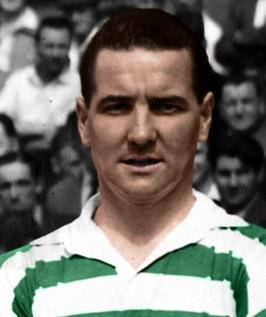
One can never say such things with any kind of certainty, but one would feel that Neil Mochan must be unique in world football for having won two winners’ medals with a club before he played a game at its home ground! Yet this was what happened in spring 1953 when “the Smiler” joined Celtic and, four games later (all played at Hampden), he was the proud possessor of two medals. Indeed, in these four games, he had been largely responsible for Celtic winning the Glasgow Charity Cup and the Coronation Cup!
1953, not to put too fine a point on it, had been dreadful for Celtic. Not without good players – Stein, Fernie, Collins, Peacock, Tully and a few others, but simply poorly led and with a Chairman still rather too obsessed with his recent triumph over the SFA over the flying of the Irish flag. He had won that battle in 1952, and that was fine – but what supporters really need is success on the field. 1953 had not produced that and the domestic season effectively came to an end as early as March 14 1953 when the team went tamely out of the Scottish Cup to Rangers at Ibrox.
But then Celtic signed Neil Mochan. It would be fair to say that he was not exactly a household name in Glasgow although he had played for Morton between 1944 and 1951. His last two years had been none too successful with Middlesbrough. Although he was undeniably Celtic daft, we were spared all the “it’s a dream come true” stuff, because the transfer for £8,000 was announced in the morning papers of May 9 1953 along with the statement that he would probably be playing in the Glasgow Charity Cup final this afternoon against Queen’s Park. Indeed he was. 40,000, a remarkable crowd, turned up to see Celtic win 3-1 and new boy Mochan described as “a new jewel in the Celtic crown” scored twice. So Neil now had a medal, little more than 24 hours since joining the club.
And he got another one 11 days later. This was the all-British Coronation Cup to celebrate the Coronation of Elizabeth II in June 1953. All games were to be played in Scotland, because London was too busy with the preparations. 4 were invited from England and 4 from Scotland. Celtic were only there because they had a big support. It was a situation not without irony that Celtic won the competition – beating Hibs in the final – when it was “meant” to be a final between Rangers and Arsenal, the two royalist establishment clubs. But Celtic beat Arsenal 1-0 on Monday May 11 to the astonishment of all. Mochan played well but it was Bobby Collins who scored the only goal of the game. 59,000 stood in amazement and watched Celtic, who had won finished eighth in the Scottish League beat the English League champions! Had Mochan made all that of a difference?
Well, yes he had, and on Saturday May 16, Celtic did it again, beating this time Manchester United, and Mochan scored a goal, picking up a lofted ball from Charlie Tully and running on to score. And then the final against Hibs, Mochan scored the first goal, a 30 yard drive which Eugene MacBride, the renowned Celtic historian likened to a shot of Andy McAtee while The Glasgow Herald goes even better and talks about McGrory. It was then – dare one use the word? – “lockdown” – time as Jock Stein and Johnnie Bonnar kept Hibs at bay, until Jimmy Walsh got a goal late in the game to make it 2-0.
So there we are! Two medals within 11 days and he had not yet played at Celtic Park! He became a fans’ favourite for his famous left foot, yet he wasn’t always loved by Mr Kelly. For example he missed the Scottish Cup final and its replay of 1955 – and Celtic lost. Yet he played in the 1954 Scottish Cup final, and the two Scottish League Cup finals of 1956/57 and 1957/58 – which Celtic won! Can anyone spot a pattern here?
And of course, there was a lot more than that to come from the Smiler!
Born in 1948, David Potter first saw Celtic at Dens Park, Dundee in March 29. It was a 3-5 defeat, which equipped him admirably for the horrors of the early 1960’s. He had “followed” Celtic for a few years before that and recalls having been called upon to impersonate Jock Stein and receive the family silver teapot which had to do for the Scottish Cup as it was presented on April 24 1954, after he and his father had spent a nerve wracking afternoon listening to the radio! Since then, he has “followed” every Celtic game with bated breath, and has written extensively about the club in magazines and books. His favorite team was that of 1969 (which he rates marginally better than 1967) and his favorite player was Henrik Larsson.
His ambition for Celtic is for them to keep on winning silver in Scotland and to be something in Europe once again. His other interests are cricket and drama. He is 70, a retired teacher of Classical Languages, married with three children and five grandchildren. He now travels on the Joseph Rafferty bus from Kirkcaldy. He also loves Forfar Athletic.
If you would like to support our Independent Celtic Fan Media Platform you can become a Member, Subscribe, Buy or Donate for the Price of a Pint. Your Support helps us continue to produce Daily News & Articles, Weekly Newsletter, Weekly Podcasts, Monthly Fanzine, Video Content & Live Shows.